
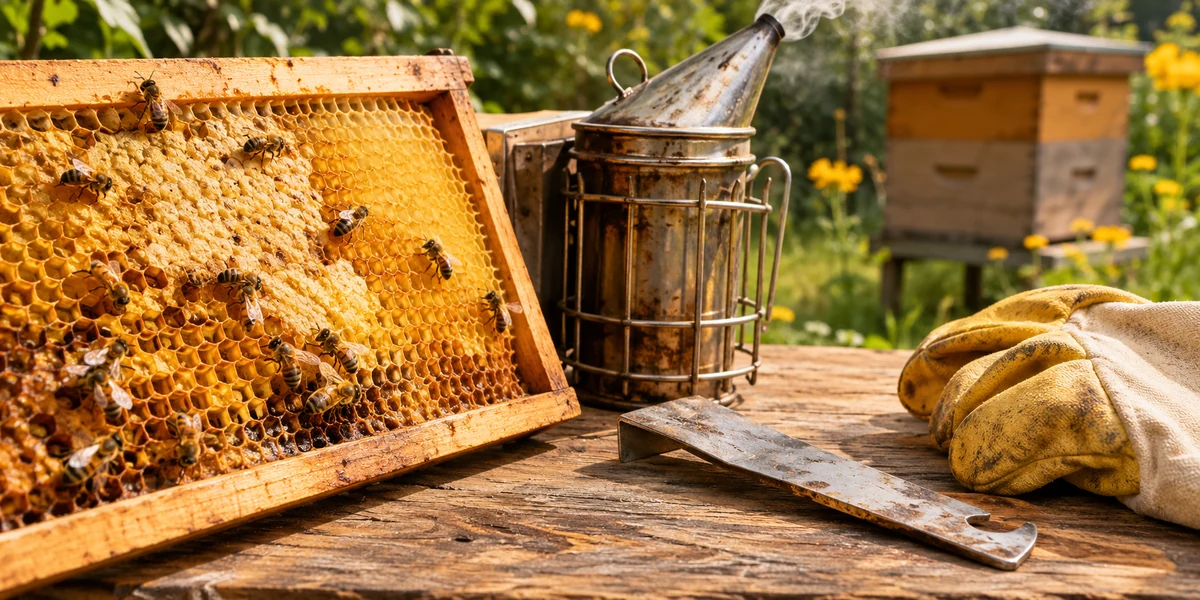
Beekeeping terminology for beginners gets practical the moment a mentor asks whether you found brood, bee bread, or queen cells. Brood means developing bees, while bee bread is stored pollen that helps nourish the colony. Queen cells are structures for raising new queens, but their presence alone does not prove swarming. Knowing these distinctions helps you record what happened before deciding whether the hive needs intervention.
Use these 50 bold terms as a field glossary, grouped by colony roles, equipment, development, food, inspection, health, harvest, and seasons. Each definition explains what you might see and which management conclusion the observation does, or does not, support.
Hive equipment names differ by region, and even familiar words can have specialized meanings. Check frame dimensions and local disease-reporting rules before applying instructions from an unfamiliar source. When you inspect, note the term and the actual evidence that supports your description.
Start by scanning the bold terms, then read the neighboring sentences for context and exceptions. Keep the glossary nearby when recording eggs, food stores, queen status, or pest monitoring results. That habit turns beginner vocabulary into concise observations you can discuss with a local mentor.
Jump to a specific section on this article
Five Terms for Honey Bee Castes and Colony Roles
Queen identifies the reproductive female whose fertilized eggs ordinarily produce workers and new queens. One healthy laying queen usually supports the colony’s ongoing brood production. Her pheromones also influence worker behavior and the colony’s social organization. A queen’s presence alone does not establish that her laying performance is adequate.
Worker means a female honey bee that performs most tasks without normally reproducing. Workers clean cells, feed brood, build comb, defend the entrance, and collect resources. Their jobs often change with age, although colony needs can shift the pattern.
Drone describes a male honey bee whose main biological role is mating with queens. Drones develop from unfertilized eggs and generally have larger eyes than workers. A colony may rear many drones during favorable reproductive conditions and remove them when resources tighten.
Nurse bee refers to a younger worker that feeds larvae and tends developing brood. Nursing depends on worker physiology, food supplies, and demands inside the brood nest. Forager refers to a worker collecting nectar, pollen, water, or plant resins outside. Observing these different jobs helps explain the colony’s division of labor during routine management.
Queens, workers, and drones are castes, whereas nursing and foraging describe worker activities. Because individual workers can change tasks, age alone does not define their current role. Record what bees are doing rather than assigning every visible worker a fixed job.
Five Beekeeping Terms for an Apiary, Frames, and Bee Space
Apiary means a place where one or more managed beehives are kept. Its layout should allow safe access, suitable water, and consideration for nearby people and animals. Hive body names a box containing comb, commonly including brood or stored food. A honey super is a box generally added to give bees room for collecting surplus honey.
Frame is the removable support that holds comb inside a managed hive box. Its top bar and side bars allow comb to be lifted without cutting it free. Frame count does not establish whether neighboring boxes and internal components will fit together.
Propolis is a sticky plant-resin material bees use to seal gaps and coat hive surfaces. Bees may seal narrow gaps with propolis, sometimes making frames difficult to separate. Bee space describes a passage narrow enough that bees generally leave it open. Many movable-frame hives use passages near six to nine millimeters, but equipment specifications should guide replacement parts.
Spacing errors can cause attachment comb that makes routine handling harder. Before choosing boxes, compare frame depths and construction details within a first-year hive setup suited to local conditions. Keep spare components matched to the system you already use.
Box names describe intended use rather than guaranteeing that bees will obey boundaries. Bees may store honey or raise brood wherever the colony’s conditions permit.
Hive Body and Super Names in Beekeeping
A brood chamber is the region where the queen lays and workers rear developing bees. Some beekeepers use one brood box, while others manage several connected chambers. Supers can contain nectar, ripening honey, or capped honey during a flow. A queen excluder is an optional screen intended to restrict a queen’s movement between boxes.
An excluder does not replace checking frames for brood before harvesting.
Bees can fill previously empty boxes at very different rates across seasons.
For a small colony, adding excessive empty space can complicate temperature regulation and defense. When the population expands, adequate comb space may reduce congestion during nectar collection. Describe the actual brood location in your notes rather than relying only on box labels.
Frames, Foundation, and Bee Space in a Hive
Frames should hang freely enough to remove without tearing attached comb. A foundation sheet can encourage straight comb, but construction still depends on worker activity. Bees commonly seal smaller gaps with propolis and build comb in larger openings. That behavior explains why component compatibility matters more than a similar-looking box.
Top bars support lifting and provide spacing across the hive body. Frame rests carry the frame ends and keep the working arrangement organized. Replace damaged pieces that pinch bees or prevent frames from seating correctly.
Drawn comb means workers have already built out usable wax cells. Undrawn foundation requires bees to invest resources before they can occupy finished cells. Newly established colonies may therefore progress slowly without a good nectar supply. Inspect foundation seating before installing bees or transferring occupied frames.
During inspections, loosen propolis gradually instead of twisting frames against neighboring comb. Keep the remaining frames upright while checking brood and food distribution. Return each frame carefully to preserve spacing and reduce accidental bee crushing.
Five Terms for Brood and Honey Bee Development
Egg means the earliest visible developmental stage, usually standing near the cell floor. Honey bee eggs typically hatch after about three days under normal colony conditions. Fresh eggs can indicate recent laying even when the queen remains unseen.
Larva describes the feeding immature stage after an egg hatches. Healthy young larvae are generally pale and curl in the bottoms of brood cells. Pupa describes the later developing stage inside a capped cell. The bee changes substantially before emerging as an adult from that protective covering.
Open brood includes eggs and uncapped larvae that workers can feed directly. Its presence can help a beekeeper judge whether recent reproduction continues. Open brood should be examined gently to avoid damaging delicate developing bees.
Capped brood means developing bees whose cells have received wax cappings. Workers normally cap brood before the pupal stage develops further. An uneven capped pattern merits a closer look at queen performance, disease signs, and colony conditions. Healthy gaps also occur when adults emerge or workers temporarily use cells differently.
Worker development from egg to adult usually takes about 21 days. Queens develop faster, while drones generally require longer than workers to emerge.
Different brood stages together tell more about colony activity than any single cell.
Five Hive Terms for Comb, Brood Cells, and Queen Cells
Brood comb describes wax comb that currently holds developing honey bees. Its cell surfaces offer clues about development, hygiene, and the colony’s reproductive activity. Worker cell refers to the smaller hexagonal cell in which workers ordinarily develop. Workers also use suitable cells for storing nectar or pollen when brood is absent.
Drone cell is larger than a typical worker cell and accommodates developing males. Bulging drone brood cappings can help distinguish these cells during an inspection. Drone-sized cells may be built along frame edges or within designated comb areas.
Queen cup means an open, cup-shaped wax structure workers may prepare for queen rearing. An empty queen cup does not prove that swarm preparations are underway. Queen cell describes the enlarged, elongated structure in which a new queen develops.
Workers can produce queen cells during swarming, replacement, or emergency queen rearing. Cell position alone cannot establish the reason for queen rearing. Penn State Extension’s queen development research explains how colony circumstances shape these different processes.
Inspect the cells’ contents and surrounding brood before interpreting their significance. A capped queen cell may hold a developing queen, but emergence must still be confirmed.
Record whether a structure is an empty cup, an occupied cell, or an emerged cell.
Five Beekeeping Terms for Foraging and Food Stores
Nectar flow describes a period when flowering plants provide abundant nectar for collection. Its timing and strength change with rainfall, temperature, plant species, and location. Fresh nectar entering the hive does not automatically mean harvestable honey will accumulate.
Dearth refers to a period of reduced nectar or pollen availability. During a dearth, food intake may decline even while adult colony populations remain high. Pollen basket names the flattened area on each worker’s hind leg that carries collected pollen. Foragers return with visible pollen loads, but that observation alone cannot measure protein reserves.
Bee bread is stored pollen mixed with bee secretions and other hive materials. Workers place it inside comb cells for later consumption by the colony. Strong brood rearing requires suitable nutrition, not simply the presence of adult foragers.
Honey stores are carbohydrate reserves held in comb cells for colony use. Bees evaporate water from collected nectar and ultimately cap much ripened honey. When interpreting food reserves, the colony’s management cycle helps connect foraging, brood demand, and harvest timing. A colony with some honey may still have insufficient accessible food for an extended dearth.
Inspect store distribution alongside brood area and the colony’s likely consumption. Heavy boxes can suggest reserves, but a weight estimate cannot reveal every frame’s contents. Keep local flowering calendars and colony records together to interpret seasonal food changes.
Five Hive Inspection Terms for Assessing a Colony
Brood pattern describes the arrangement of developing bees across a comb face. A compact pattern can support an assessment of laying activity, although ordinary emergence creates gaps. Queenright means a colony has a functioning queen, evidenced by appropriate brood or other observations.
Seeing fresh eggs is useful evidence of recent laying but does not verify current queen survival. Hive tool identifies the pry-and-scrape implement used to release propolis-sealed hive components. The tool should separate frame edges gently without crushing bees or tearing comb. Keep inspection movements organized so uncertain findings can be checked again later.
Smoker is the bellows-operated device that introduces cool smoke during some hive examinations. For a guarded design, the VIVO BEE-V001 Stainless Steel Beehive Smoker with Heat Shield has an eleven-inch overall height. Its manufacturer’s stated four-inch canister diameter describes the standard model rather than the larger variant.
Veil denotes protective mesh that separates a beekeeper’s face from flying bees. During inspections, the Humble Bee 22-ST Aero Square Veil, Standard, Field Tan provides a framed mesh barrier. Protective clothing needs correct fit, secure closures, and a careful check before opening a hive. Even with a veil, keep an appropriate exit route and avoid standing directly in front of entrances.
Calm, deliberate handling makes the practical demands of inspection easier to manage during an unfamiliar season. Write what you saw before labeling a colony queenless, weak, or diseased. A clear record separates evidence, interpretation, and the next action.
Five Terms for Honey Bee Behavior and Colony Changes
Waggle dance describes a worker’s movement that communicates information about a resource’s direction and distance. Other bees use these signals alongside odors and their own exploration. Dance activity does not prove that a nectar source will remain productive.
Robbing occurs when bees take honey or other resources from another colony. Fighting near hive entrances may indicate robbing rather than a productive nectar flow. Nucleus colony, or nuc, contains bees, brood, food, and usually a laying queen on a small set of frames. Starting with a nuc can shorten establishment time when its frame format and health status suit the apiary.
Swarming is the natural reproductive division of a colony when a queen departs with workers. The parent colony retains brood and may rear or release a replacement queen. Swarm signs require context because cups and cells appear under several circumstances.
Supersedure describes workers replacing a poorly performing or aging queen within the colony. A supersedure event may temporarily leave both queens present before the transition completes. When managing a single colony, losing a laying queen can create a particularly important monitoring problem. Keep notes on eggs, larvae, queen cells, weather, and the interval between inspections.
These terms describe behavior and colony changes rather than fixed diagnoses from one glance. Compare inspection records before altering a colony’s population or interrupting queen replacement.
Five Beekeeping Terms for Pests and Disease Checks
Varroa mite names the external parasite Varroa destructor that harms honey bees and transmits viruses. Reproducing mites occur within capped brood cells and can be missed during quick visual inspections. Mite load describes the number or proportion of mites detected in a sampled colony population.
A sample-based estimate is more informative than counting visible mites on adult bees. Alcohol wash is a monitoring method that dislodges mites from a measured adult-bee sample. The sampled bees die during a conventional alcohol wash, making sampling technique important. For standardized handling, the Foxhound Bee Company Varroa Easy Check Mite Tester provides a filtering cup for separating mites.
Hygienic behavior refers to workers detecting and removing diseased or compromised developing brood. Breeding programs may evaluate this behavior, but observation alone cannot establish resistance levels. Continue quantitative mite monitoring even when a colony appears vigorous.
American foulbrood is a serious bacterial brood disease caused by Paenibacillus larvae. Suspicious brood signs require careful assessment and may trigger mandatory reporting under local rules. Never move potentially contaminated frames between colonies while an unresolved brood problem remains.
Disease names should be tied to evidence rather than assumed from a single symptom. Keep records of sample size, test method, date, brood condition, and any advice received.
Five Terms for Honey Harvesting and Storage
Uncapping means removing the wax seals from capped honey cells before extraction. An uncapping knife or fork exposes the honey without necessarily destroying the comb. Extractor identifies equipment that uses centrifugal force to remove honey from frames. Its frame compatibility and operating method matter when planning a small harvest.
Crystallization occurs when dissolved sugars, especially glucose, form solid crystals in honey. This natural change does not by itself mean the honey has spoiled or fermented. Its speed varies with floral origin, storage temperature, and the honey’s sugar composition.
Cappings wax describes the wax removed with the seals during uncapping. It often contains residual honey that can be drained or separated during processing. Food-contact tools and clean containers help prevent avoidable contamination during collection. Keep cappings handling separate from any wax or materials exposed to unsuitable chemicals.
Refractometer measures honey’s refractive properties to estimate moisture content. Moisture readings help assess fermentation risk in honey destined for storage. Temperature compensation and calibration affect how a particular instrument should be used.
Capped appearance offers a useful cue, but it does not replace checking uncertain honey moisture. Never harvest brood frames or remove resources the colony still needs to survive. Processing methods should follow local food-handling rules and the intended use of the honey.
Five Seasonal Hive Terms for Feeding and Winter
Brood break means a temporary interruption in egg laying or developing brood production. It can follow swarming, queen replacement, seasonal conditions, or deliberate management. A brood break affects population replacement and changes where varroa mites can reproduce. Distinguish a predictable interruption from prolonged queenlessness before choosing an intervention.
Winter cluster is the aggregation of adult bees that conserves heat during cold weather. Workers generate and redistribute warmth while the cluster shifts toward accessible food. Clustering varies with climate, so tropical colonies may experience different seasonal pressures.
Winter stores describe the food reserves intended to sustain a colony through reduced forage. Adequacy depends on colony size, season length, temperature, and local flowering conditions. Bees may starve near inaccessible food during prolonged cold conditions.
Sugar syrup is a liquid supplementary carbohydrate feed used in selected management situations. Feeding schedules and concentrations vary with the colony’s goals and local climate. Keep syrup away from honey supers intended for a genuine floral honey harvest.
Fondant refers to a soft sugar feed often positioned where clustered bees can reach it. Placement matters because workers may not cross cold, empty comb to reach distant stores. Supplemental feed does not replace monitoring for parasites, queen problems, and poor ventilation. Inspect external activity and hive weight when opening the colony would cause unnecessary disturbance.
Build seasonal decisions around observed stores and climate rather than calendar labels alone.
Beekeeping Glossary: 50 Essential Hive Terms From A to Z
This quick-reference glossary collects all 50 terms explained in the sections above and arranges them alphabetically. Open the list when you need a plain-language definition during a lesson, inspection, or conversation with a mentor. Each short entry identifies the term, while the full article explains its practical context.
Show 50 beekeeping terms and short definitions (A to Z)
- Alcohol wash
- A mite-counting test using alcohol to dislodge mites from a measured bee sample.
- American foulbrood
- A serious bacterial brood disease caused by Paenibacillus larvae.
- Apiary
- A location where one or more managed beehives are kept.
- Bee bread
- Stored pollen prepared with bee secretions and other hive materials.
- Bee space
- A narrow passage that bees generally leave open inside a hive.
- Brood break
- A temporary interruption in egg laying or developing brood production.
- Brood comb
- Wax comb currently holding eggs, larvae, or pupae.
- Brood pattern
- The arrangement of developing bees across the surface of comb.
- Capped brood
- Developing bees enclosed in brood cells sealed with wax.
- Cappings wax
- Wax removed from sealed honey cells during harvesting.
- Crystallization
- The natural formation of sugar crystals in stored honey.
- Dearth
- A period when nectar or pollen sources are scarce.
- Drone
- A male honey bee whose main reproductive role is mating.
- Drone cell
- A larger brood cell normally used to raise male bees.
- Egg
- The earliest stage of honey bee development inside a brood cell.
- Extractor
- Equipment that spins frames to remove honey using centrifugal force.
- Fondant
- A soft sugar-based feed offered in suitable management conditions.
- Forager
- A worker bee collecting nectar, pollen, water, or resin outside.
- Frame
- A removable structure that supports comb within a hive box.
- Hive body
- A hive box containing comb, often including brood or food.
- Hive tool
- A metal implement for separating and scraping hive components.
- Honey stores
- The colony’s food reserves held as honey in comb cells.
- Hygienic behavior
- Workers’ detection and removal of diseased or compromised brood.
- Larva
- The feeding immature stage between egg and pupa.
- Mite load
- An estimate of mite infestation in a sampled bee population.
- Nectar flow
- A period when flowering plants supply abundant nectar.
- Nucleus colony
- A small colony with bees, brood, food, and usually a queen.
- Nurse bee
- A worker bee that tends and feeds developing brood.
- Open brood
- Eggs and larvae in cells that have not been capped.
- Pollen basket
- A specialized area on a worker’s hind leg that carries pollen.
- Propolis
- Plant-resin material bees use to seal gaps and coat surfaces.
- Pupa
- The developing stage inside a capped brood cell before emergence.
- Queen
- The reproductive female that lays most eggs in a colony.
- Queen cell
- An enlarged wax cell in which a new queen develops.
- Queen cup
- A cup-shaped wax structure that may be used for queen rearing.
- Queenright
- Describing a colony with a functioning queen.
- Refractometer
- An instrument used to estimate the moisture content of honey.
- Robbing
- Bees taking stored food from a different colony.
- Smoker
- A bellows-operated tool used to apply smoke during inspections.
- Sugar syrup
- A liquid sugar solution used as supplemental carbohydrate feed.
- Supersedure
- The replacement of an existing queen by another queen.
- Swarming
- A colony dividing when a queen departs with some workers.
- Uncapping
- Removing wax seals from honey cells before extraction.
- Varroa mite
- A parasitic mite that harms honey bees and spreads viruses.
- Veil
- Protective mesh covering a beekeeper’s head and face.
- Waggle dance
- Worker-bee movements communicating information about resource location.
- Winter cluster
- Bees gathering closely to conserve heat in cold weather.
- Winter stores
- Food reserves intended to sustain a colony through reduced forage.
- Worker
- A female bee performing most routine colony tasks.
- Worker cell
- A smaller comb cell used to raise workers or store food.
A definition gives you the right word, but careful inspection records show whether that word applies to your colony. The frequently asked questions below address situations that need more context than a glossary entry can provide.
Frequently Asked Questions about Beekeeping Terminology for Beginners
Do Beekeeping Terms Vary Between Countries?
Yes, some equipment names, abbreviations, and management expressions vary between countries and beekeeping traditions. A box described as a super in one discussion may hold brood in another setup. Measurement systems and standard hive designs also differ by region. Confirm what the speaker means before ordering parts or applying an unfamiliar technique.
Biological terms such as larva and drone are more stable than local equipment labels. However, common names for pests sometimes conceal distinct species with different management requirements. Scientific names help separate organisms when everyday labels are ambiguous.
Regulatory terms deserve particular attention because disease reporting and treatment rules are jurisdiction-specific. Use the terminology of your local bee inspector when describing suspected notifiable disease. Include measurements or photographs in records where a name alone could cause confusion.
Which Beekeeping Abbreviations Should Beginners Recognize?
Start with NUC, which commonly shortens nucleus colony, a small working colony established on frames. IPM means integrated pest management, an approach combining monitoring and suitable control methods. AFB and EFB refer to American foulbrood and European foulbrood, two different brood diseases. SHB usually means small hive beetle in discussions of hive pests. Keep a short personal abbreviation key because local associations may use additional shorthand.
How Can I Remember Beekeeping Terms During Hive Inspections?
Connect each term to one direct observation in your inspection notebook. Write capped brood beside a description of the cell pattern you actually saw. Record queenright only when the available evidence supports that interpretation. Revisit uncertain labels afterward with a mentor instead of extending inspections unnecessarily.
Group notes by bees, brood, food, behavior, and health rather than memorizing alphabetically. Add the date and colony identifier so changes can be compared over time. Repeated use in real observations builds familiarity more reliably than copying definitions alone.
Do Honey Bee Terms Also Apply to Bumblebees and Solitary Bees?
Some biological words apply broadly, but many hive-management terms specifically describe honey bee colonies. Eggs, larvae, pollen, and nectar occur across many bee groups. Worker, queen, and drone descriptions require care because social organization differs among species. Langstroth frames, honey supers, and routine extraction describe managed honey bee equipment.
Bumblebees form seasonal social colonies with their own reproductive and worker patterns. Most solitary bees do not maintain perennial colonies with a division of worker labor. A bee nesting alone is not therefore a queenless honey bee colony.
Identify the bee species before transferring advice between different nesting systems. Many wild bees need protected nesting habitat rather than movable-frame hive inspections. Species-specific ecology prevents terminology from turning into harmful or irrelevant management.
Can a Colony Be Queenright If I Cannot Find the Queen?
Yes, a functioning queen may be present even when you cannot locate her. Fresh eggs and young larvae can provide evidence of recent egg laying. A consistent brood pattern adds context but cannot prove the queen is alive today. Search calmly without repeatedly shaking or exposing every brood frame. Record the age of visible brood and return when new evidence will be available.
A colony may still contain young brood after losing its queen recently. The absence of eggs also warrants context during a predictable brood break. Combine dated observations with colony behavior before deciding that queen replacement is necessary.
Do Queen Cells Always Mean a Bee Colony Will Swarm?
No, queen cells can signal swarming, supersedure, or emergency queen replacement. Swarm preparations often occur in strong colonies facing particular reproductive conditions. A failing queen may instead prompt workers to raise a replacement within the colony. Sudden queen loss can also trigger emergency cells from suitable young larvae.
Examine brood ages, colony strength, and the arrangement of occupied cells. Cell location offers a clue but cannot establish the cause by itself. Recent inspection records are valuable when the colony’s queen status changes.
Destroying every queen cell can leave an already queenless colony without a replacement. Confirm whether an old queen is still laying before choosing a response. When uncertain, consult an experienced local beekeeper with the complete inspection findings.
Document what changed between visits instead of interpreting one photograph as a final diagnosis.
Does a Nectar Flow Always Produce Surplus Honey?
No, an abundant nectar flow does not automatically create honey available for harvesting. Workers may use incoming nectar to feed brood or rebuild depleted reserves. Rain, colony population, temperature, and flowering duration alter how much nectar is collected. Assess the colony’s own needs before treating newly filled comb as surplus.
Can a Bee Colony Have Food Stores and Still Need Feeding?
Yes, a colony may need support when available food is inadequate or inaccessible. Stores concentrated far from a cold cluster may not prevent starvation. A rapidly expanding brood nest can also increase consumption during unreliable forage. Evaluate food quantity, placement, colony size, and likely weather together.
Choose supplemental feed according to the colony’s needs and local seasonal practice. Avoid mixing artificial feed into honey intended to represent floral nectar. Check how bees can reach the feed without forcing unnecessary disruption.
Does Finding a Hive Pest Always Mean the Bees Are Diseased?
No, finding a pest does not by itself establish that the colony has a disease. Small hive beetles can be present without obvious damage in some colonies. Varroa mites require quantitative monitoring because infestation severity can change rapidly. Disease identification relies on appropriate symptoms, samples, and sometimes laboratory confirmation.
Separate pest presence, infestation level, and actual clinical disease in your notes. A colony can look active while harmful parasites or pathogens accumulate. Conversely, unusual brood appearance may arise from causes other than infection.
Use recommended monitoring methods before selecting a control strategy. For suspected serious brood disease, follow local inspection and reporting procedures. Avoid transferring suspect frames or equipment until the cause is properly assessed.
Why Do Beekeeping Books Use Scientific Names for Some Pests?
Scientific names identify particular organisms more precisely than many common pest names. Varroa destructor distinguishes the important parasitic mite from other mite species. Paenibacillus larvae names the bacterium responsible for American foulbrood. Such names reduce confusion when reading research from different countries.
Taxonomic names can change when scientific classification improves or new evidence emerges. A reference may therefore include an older name alongside its current accepted form. Check the publication date before assuming two labels describe different organisms.
Common names remain practical for everyday conversations with other beekeepers. Scientific names become especially useful when verifying disease advice or regulatory requirements. Match the organism and region before transferring a treatment recommendation between sources.
Record the exact name provided by a laboratory or official inspector when one is available.
A Few Last Things to Know About Beekeeping Terminology for Beginners
These 50 terms explain what beginners are observing across the apiary, from comb building to seasonal feeding. Their real value comes from matching each definition to evidence inside a particular colony. A clear inspection note separates what you saw from what you think it means.
At your next inspection, choose five unfamiliar terms and write down one observation relevant to each. Compare those notes against local extension guidance before deciding whether action is needed. Repeating this practice makes beekeeping terminology for beginners useful during real decisions, not just vocabulary quizzes.