

How much time does beekeeping take across a typical year? There is no dependable weekly figure for every keeper. Work rises and falls with colony condition, forage, weather, colony count, travel and experience. Estimate the tasks at your site first. Then allow time for periods when a colony needs a timely decision.
Use this guide to build an estimate from your own tasks. It separates time spent at the hive from the travel, preparation, learning and follow-up that often disappear from a beginner’s calculation. The downloadable planner and spreadsheet let you record your own numbers instead of borrowing an average from a different climate.
Jump to a specific section on this article
Contents
How much time does beekeeping take during each season?
A colony does not need the same attention every week. Brood rearing, forage, food stores, pests, weather and the amount of space available all change. A period of growth may bring several management questions close together. A quiet interval may require observation and equipment care rather than a full inspection. The local pattern depends on climate, elevation, plants, land use and the way the apiary is managed.
There is also a difference between planned and triggered work. A planned visit may be scheduled to monitor a particular condition. A triggered visit becomes necessary after a sign, weather event, equipment failure or concern changes the plan. Some tasks can be moved by a day or two. Others need timely local advice. A useful estimate includes both the expected visits and the possibility that a period becomes busier.
Colony count changes total work, but not always in a one-to-one ratio. Travel and setup may be shared across several hives, while inspection, records and health checks remain colony-specific. One colony can require substantially more attention than another if it has a problem. If you are comparing a one-hive and two-hive plan, model shared and per-colony tasks separately.
Experience changes duration as well. A beginner may spend longer identifying frames, asking questions and writing notes. That learning time is productive and should be counted. Do not assume that an experienced beekeeper’s inspection time will be your first-year time. For context on how those tasks arise, see what a first beekeeping season can involve.
Which tasks belong in an annual beekeeping time estimate?
Count the whole job, not only the minutes when a hive is open. Before a visit, you may prepare the smoker, protective clothing, hive tool, water and record sheet. Afterward, you may clean equipment, file notes, consult a mentor, schedule a monitoring check or repair a frame. If the apiary is not at home, travel can be a substantial share of each visit.
| Task group | What to include | How to record it |
|---|---|---|
| Travel and access | Round trip, parking, walking equipment to the site | Minutes per visit and visits per local season |
| Preparation and cleanup | Protective clothing, smoker setup, tool cleaning, safe storage | Separate before and after time from hive time |
| Observation and inspection | Entrance checks, focused frame checks, records made on site | Record purpose and conditions for each visit |
| Health monitoring | Sampling, result interpretation, follow-up or locally required contact | Record method, date and any repeat check |
| Equipment work | Frame assembly, repairs, box cleaning, preparation for a transition | Count work sessions, not just one-time purchase |
| Learning and coordination | Classes, mentor calls, supplier pickup, inspector appointments | Include travel and preparation for appointments |
| Harvest or processing | Assessing surplus, extracting, cleaning, bottling and labeling | Include shared labor and equipment return time |
Keep “routine observation” separate from “inspection.” Watching the entrance for a few minutes can be useful between hive openings. A full inspection requires protective gear, tools, a question to answer and a careful close. If your records combine them, the estimate becomes hard to update because the visits do not serve the same purpose.
How can you calculate your own annual beekeeping hours?
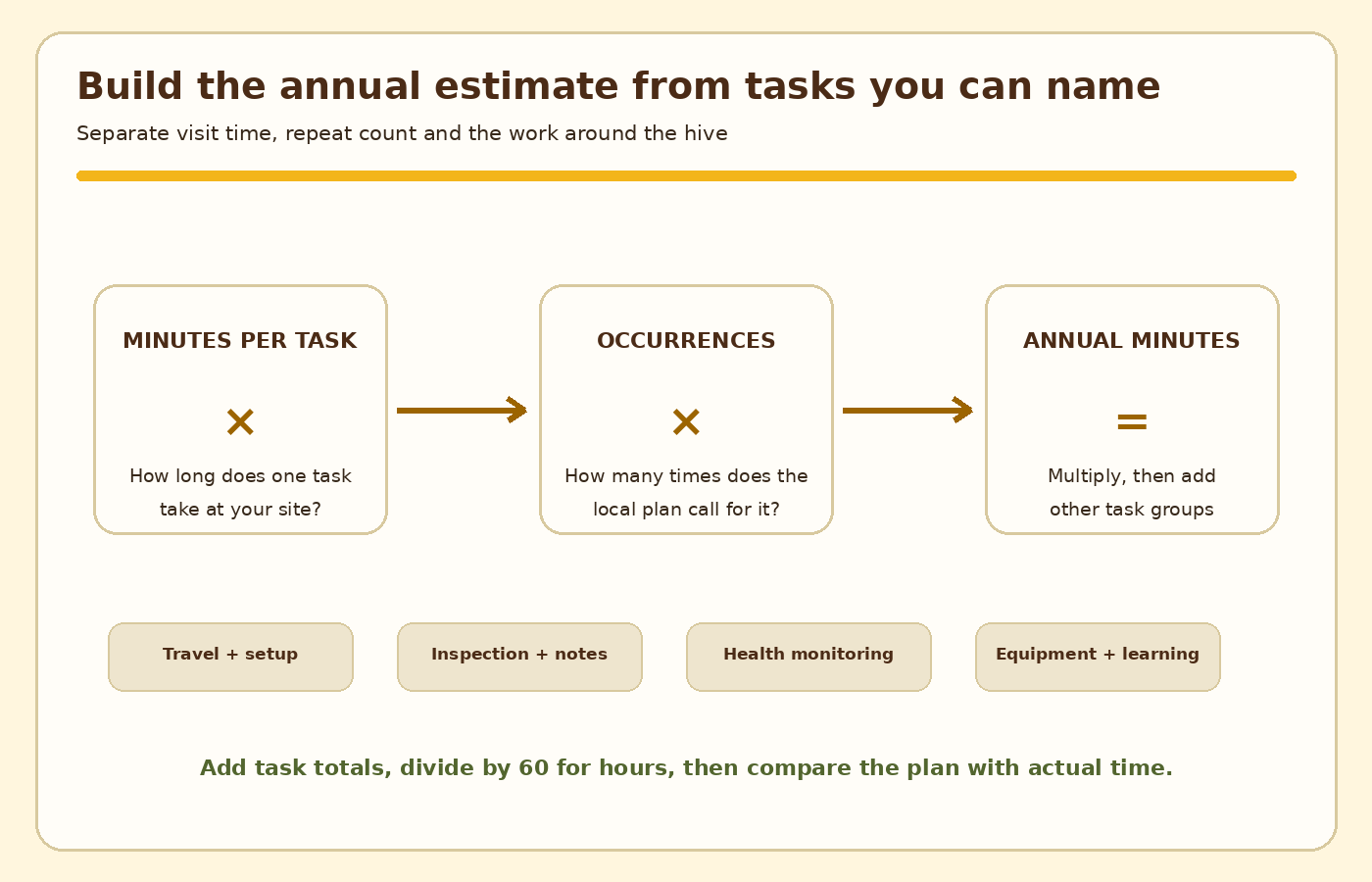
For each task, estimate minutes per occurrence and the number of occurrences you expect in your local year. Multiply those values to get annual minutes.
Add each task category, then divide the total by 60 for hours. In formula form: annual minutes for one task equals minutes per occurrence multiplied by occurrences per year.
Here is a deliberately hypothetical example. Suppose a keeper budgets 45 minutes of preparation and cleanup for each of 10 visits. That category is 450 minutes, or 7.5 hours. If travel takes 70 minutes round trip for those same 10 visits, travel adds 700 minutes, or 11 hours and 40 minutes. The combined total for those two categories is 1,150 minutes, or 19 hours and 10 minutes. These are sample inputs for arithmetic only. They are not a recommended inspection frequency or a beekeeping average.
Then add tasks that happen on their own schedule: equipment assembly, a course, a mentor visit, health monitoring and any harvest work. Avoid double counting. If your on-site inspection estimate already includes writing notes, do not add the same note-taking minutes again in a separate category. If a mentor accompanies an inspection, count only the extra travel or discussion time that is not included in the visit.
Use a range when duration is uncertain. You might enter a low and high estimate for travel or repairs, then note what would move the result toward one end. A range is more honest than a precise total built from guesses. After a few months, replace estimated durations with actual times from your records.
Which parts of a beekeeping visit do new keepers often forget?
Travel is commonly omitted, especially when the hive is kept at a second property or community apiary. The visit begins when you gather gear and ends after tools are cleaned and notes are complete. If the route includes a gate, an uneven walk, shared access or a long drive, include it. A close backyard hive and a remote farm hive can have very different time costs even when the inspection is similar.
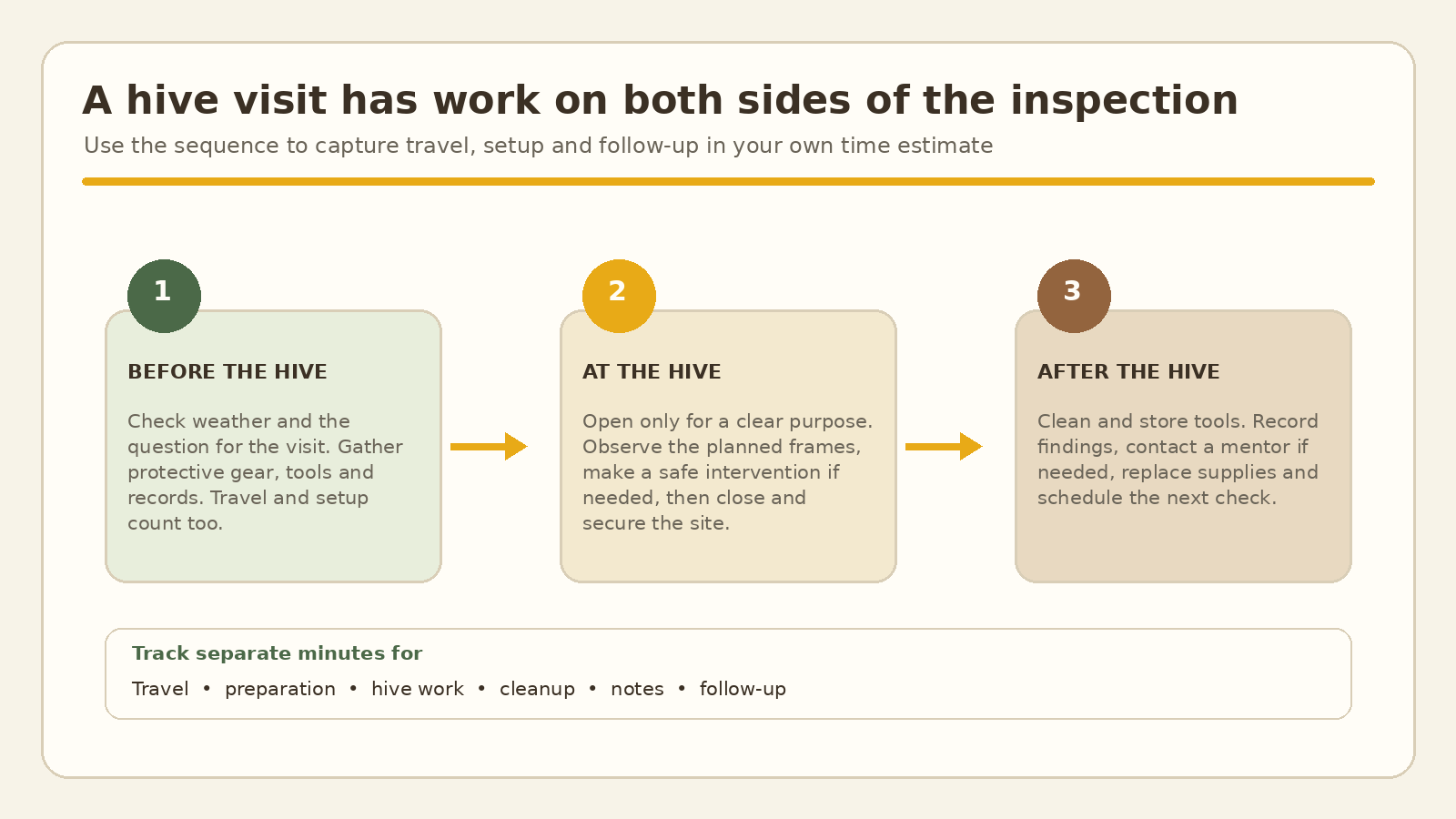
Preparation can take longer while you learn. You may need to assemble a frame, check protective gear, refill a smoker, read a local notice or message a mentor.
Those tasks often become more efficient after routines are established, but they do not disappear. Keep them in a separate row so you can see what experience changes.
Follow-up is also real work. A result may prompt a second sample, a call to an inspector, a treatment plan, a later check or equipment cleaning. Do not assume a health concern will fit into the planned visit. If your schedule has no room for a follow-up, discuss a backup arrangement before starting.
Learning hours count. A class, a demonstration, reading local disease guidance or practicing frame handling all make future work more informed. They are not optional overhead in the first year. Set aside time for them in the same annual estimate as hive tasks, especially before installation and before a management decision you have not performed.
How do you estimate work during growth and forage periods?
Begin with the local sequence of colony changes rather than months. Ask which cues signal that brood is building, a main forage period is approaching or swarm preparation needs closer attention. Then estimate the tasks that commonly accompany each phase for the type of hive and colony you plan to keep. A calendar from another region may explain the idea but cannot supply your local frequencies.
During active growth, a keeper may need to check space, brood, stores and swarm-related cues. How often this happens depends on colony strength and local practice. A new nuc and a large overwintered colony do not have the same workload. Make the assumptions explicit: number of colonies, distance to the site, local advice and expected duration of each task.
During a strong forage period, bees may bring in resources rapidly. The keeper might assess whether space is available, whether the colony is developing as expected and whether any harvest decision is appropriate.
Those tasks can cluster. If you can only visit on weekends, ask a mentor how to plan around the local flow and what a backup keeper should know.
Use the source of local timing carefully. Utah State University’s beekeeping annual calendar is organized around Utah conditions and illustrates the value of seasonal planning. Do not transfer its dates, bloom sequence, store targets or management actions to another region. Ask your local association or agricultural extension resource which cues matter at your site.
How do you budget time for health monitoring and unexpected work?
Health monitoring requires more than a number in a notebook. The method must be learned and performed correctly. The result needs to be interpreted against the appropriate local threshold. A treatment, if recommended, may require planning, product handling, follow-up and attention to label restrictions. Schedule the monitoring task separately so it does not vanish inside a general “hive check.”
Some work cannot be predicted exactly. A colony may need a repair, a second visit or help with a suspected disease. A weather window may close before a planned inspection. Leave some unscheduled time in your estimate. The reserve is not a forecast that something will go wrong. It prevents the annual plan from assuming that every visit lasts exactly as long as the last one.
Identify who can cover an urgent task if you are unavailable. A backup should know the location of the hive, the contact person, the colony records and which actions require your approval. Do not ask an untrained person to perform a complex intervention simply because your calendar is full.
Equipment and health issues can overlap. If frames need to be moved or replaced, that work may create a second inspection. If the colony is suspected of disease, sanitation and movement restrictions may apply. Ask a local inspector what records to keep and what not to transport. A little time spent finding the correct procedure can prevent a much longer problem.
Does keeping two hives take twice as much time as one?
Not necessarily. Some tasks are shared: travel, opening the equipment box, cleaning the smoker and preparing records. Other work remains colony-specific. You still need separate observations, records, monitoring results and management decisions. One colony may be straightforward while the other needs extra attention.
Use separate estimates for fixed and variable work. Fixed work includes the round trip and setting up gear. Variable work includes inspecting each colony, recording its condition and any follow-up.
If two hives are next to each other, setup and travel may be shared. If one is at a second location, much of the travel repeats.
There is a learning benefit to comparing colonies, but comparison can mislead if the colonies differ in age, genetics, starting condition or hive setup. A mentor can help explain what the differences mean. Do not treat one colony’s growth as proof that the other is failing.
If you begin with one hive, consider whether a second colony is compatible with your site and the time you have. If local beekeepers advise that two colonies are more educational or manageable in your situation, incorporate that information into the task model. There is no universal multiplier.
How can a beginner reduce wasted time without rushing the colony?
Prepare a question before each inspection. Gather the tools and protective equipment in one place. Keep a repeatable record sheet and place it where it can be used safely. These steps shorten the time spent searching, deciding what to inspect or reconstructing observations afterward.
Learn frame handling before the season begins. A novice can spend a long time moving frames, especially if the hive tool or grip is unfamiliar. Practice with empty frames or observe a mentor. The purpose is steady control, not speed. Rushing risks damaging comb, crushing bees or leaving the hive open too long.
Make the visit only as broad as the management question requires. If you are checking a specific pest-monitoring result, follow that method. If you need to assess stores, learn which frames provide relevant evidence. Do not remove every frame on every visit by habit.
Schedule maintenance outside the busiest periods when possible. Assemble frames, repair boxes and clean storage areas before the time they are needed. Keep spare parts compatible with the hive system. A prepared kit cannot remove the uncertainty of colony management, but it prevents simple equipment problems from consuming a short weather window.
What should your first-year time plan look like?
Build a plan with task, local trigger, expected frequency, minutes, actual minutes and next action. A “trigger” is a cue that tells you when a task matters.
It could be a local bloom, scheduled pest sample, weather change, or colony sign. The trigger is more useful than a month copied from a distant calendar.
| Task | Local trigger or reason | Estimated minutes | Actual minutes | Follow-up |
|---|---|---|---|---|
| Travel and access | Every apiary visit | Enter your round-trip estimate | Record after travel | Check whether a closer site or shared trip is possible |
| Entrance observation | Between focused inspections | Use your observation window | Record on the day | Note flight, weather and forage |
| Focused inspection | Question set by local plan or colony sign | Estimate preparation, hive work and notes | Record each component | Write the next question |
| Health monitoring | Locally recommended interval or threshold | Include sample and result recording | Record method and time | Follow the local decision rule |
| Equipment preparation | Before a known seasonal transition | List parts and assembly time | Record actual workshop time | Keep compatible spares ready |
| Mentor or training | Before purchase and during unfamiliar tasks | Include travel and course time | Record questions answered | Practice the next skill |
Use the downloadable beekeeping year workload planner (PDF) to map tasks and local triggers on paper. The editable beekeeping time calculator (XLSX) multiplies minutes per task by expected frequency and totals the estimate. Both are planning aids; neither supplies a recommended inspection schedule.
Revisit the estimate after the first few months. Compare planned and actual minutes. If travel dominates, consider whether a closer apiary or shared transport is possible. If follow-up work repeatedly exceeds the plan, add a reserve or a trained backup. If learning tasks take longer, keep them in the model instead of treating them as wasted time.
How should you handle time away from the apiary?
Absence planning starts with the colony’s condition and the local season. A fixed absence interval cannot be declared safe for every hive. Before travel, ask a local mentor what checks are appropriate, whether a trained person should monitor the colony, and which signs require a call. Leave the contact information and relevant records where the backup can find them.
Agree on the backup person’s role. They may be able to observe the entrance and report a problem without opening the hive. A more experienced helper may be able to perform a defined task. Do not hand over pesticide or medication decisions without training and clear local guidance. A backup plan should identify who is authorized to act and who should be contacted first.
If the colony has a known issue, arrange help before leaving. Record the last inspection, the monitoring result, food assessment, recent treatment and the date of any planned follow-up. A one-line note such as “check later” is not enough for another person to know what matters.
How can you model a season without pretending to know the average?
Start with a model that reflects how your own apiary is managed. Name each colony, task and local trigger. If you will travel to two sites, separate the journeys. If you expect to attend a class before installing bees, include its duration and travel.
If you have arranged a mentor to accompany the first inspections, include the time for those visits. A model is useful when you can explain where each input came from.
Use a low and high estimate for uncertain tasks. Suppose the travel time is reliably 50 minutes each way, but a visit may take 30 to 75 minutes depending on the inspection question. Enter the travel once per trip and the on-site estimate separately. The range keeps the calculation honest. It also shows that even a modest number of visits can occupy more time than the hive work alone.
Do not multiply a single inspection duration by a guessed number of weeks. Use local advice to decide the tasks and conditions that create a visit. Then use actual logs to revise frequency. For example, if a mentor says the local growth period requires closer attention, reflect that in the model. If a weather period blocks access, note how that changes the visit plan. This approach produces an estimate that can be tested against your first season.
Keep assumptions beside the numbers. Write “mentor estimate,” “last season’s personal record,” or “planning placeholder.” If a number is only a placeholder, avoid presenting the total as a prediction. The calculator will add the values you enter, but it cannot decide whether the entries represent your location.
How do travel distance and apiary access change the estimate?
Travel time can dominate an otherwise short visit. A nearby hive may take only minutes to reach. A remote apiary may require planning for a gate, vehicle, farm work, or weather. Include the time required to gather protective clothing and tools before departure. If the site is shared, include any access arrangements that have to be coordinated.
Travel also affects whether a short-notice visit is practical. A keeper who lives far away may need a local partner to observe a concern or report a change.
Include the time for those check-ins and the effort to coordinate with another person. If several colonies are at one site, shared travel should be recorded once while colony-specific inspection and recordkeeping remain separate.
Site access can change over the year. Rain may make a track difficult. Vegetation may block the route or obscure the entrance. Farm machinery or seasonal work may temporarily restrict access. Ask the landowner or local mentor when access is least reliable. If you carry boxes over uneven ground, allow extra time. Arrange help when needed instead of estimating the route like a clear pavement.
How should you update a beekeeping time budget after each visit?
Record planned and actual times close together. If a visit takes longer, record why. The colony may need follow-up, a frame may be hard to lift, the smoker may need attention, or rain may slow the route. This explanation helps you decide whether the difference is a one-time event or a recurring part of the work.
At the end of a local season, compare task groups rather than only the total. Did travel exceed hive time? Did learning take more time than expected? Were health checks more frequent? Did equipment assembly happen in a large batch? This breakdown helps you plan the next season more accurately and identify where a shared resource could help.
Do not trim an estimate simply to make beekeeping fit a schedule. If the work regularly exceeds your available time, adjust the setup. Reduce the number of colonies, move closer if possible, share tasks with an experienced partner, or delay expansion. The colony’s needs determine the workload, not a preferred number in a spreadsheet.
For the decisions that create much of the first-year work, read how to plan a first colony before ordering bees. The guide to how beekeeping works from installation through harvest shows why inspection and follow-up times change with colony development.
FAQs: What questions do beginners ask about the time beekeeping takes?
How many hours a week does one hive take?
There is no reliable weekly average for every site. The time depends on seasonal tasks, travel, colony condition, experience and the local management plan. Estimate from specific tasks and update the figure with your own records.
Is beekeeping more time-consuming in the first year?
It often includes extra learning, setup and equipment work. A beginner may also need a mentor’s time and more time to handle unfamiliar tasks. The exact difference depends on the site and the support available.
Can I leave my colony alone for several weeks?
Do not set an absence interval without local advice. Colony needs and risks change with season and condition. Before travel, arrange a knowledgeable person who can respond if a concern arises.
Does more than one hive take twice as long?
Some tasks, such as travel and preparation, can be shared. Inspections, records and health checks remain colony-specific, and one hive may need more attention than another. Estimate shared and per-colony tasks separately.
What is a realistic time commitment for beekeeping?
A realistic commitment is the total of your local tasks, including travel, preparation, learning, health monitoring and follow-up. It will not be identical each week, and no generic number can guarantee that your hive will fit a busy schedule. Before starting, use local cues to estimate the work, leave room for an unplanned visit and identify a trained backup. So, how much time does beekeeping take? It depends on your local tasks, travel, changing conditions and access to capable backup; leave room for an unplanned visit.