The beekeeping learning curve becomes manageable when you learn colony biology before trying advanced hive manipulations. A new beekeeper needs to interpret what bees are doing, not merely memorize a list of chores. Handling frames, assessing brood, and measuring mites form a more useful foundation than collecting specialized equipment. The right order is preparation, supervised observation, routine decisions, and only then advanced colony manipulations.
Before owning bees, learn bee biology, protective equipment, and safe movements using an empty hive. A mentor can help distinguish ordinary seasonal variation from a problem that deserves prompt attention.
Your first supervised visits should focus on calm frame handling and recognizing eggs, brood, pollen, and honey. Once those signs are familiar, record changes, judge food and space, and learn quantitative mite monitoring. Swarm management, harvesting, and expansion make more sense once those basics are reliable.
The exact timetable changes with local nectar flows, weather, and the condition of your bees. During your first active season, repeat the basics until you can explain each decision from recorded evidence. This progression gives beginners practical milestones without assuming every colony follows the same calendar.
Jump to a specific section on this article
Contents
The Beekeeping Learning Curve Begins With Bee Biology
Begin by recognizing the queen, female workers, and male drones as distinct members of a honey bee colony. The queen primarily lays eggs, while workers handle brood care, foraging, ventilation, and defense. Drones develop from unfertilized eggs and primarily contribute to mating with virgin queens. Understanding these roles helps explain why the colony’s needs change during the season.
- Understand bee roles and the stages of brood development.
- Practice calm, safe equipment setup and frame handling.
- Identify eggs, larvae, capped brood, pollen, nectar, and honey.
- Inspect with a specific question and keep useful field records.
- Assess stores, usable comb, weather, and available hive space.
- Measure Varroa mite levels before evaluating treatment choices.
- Adapt hive tasks to local forage, weather, and colony changes.
- Recognize swarm preparations before considering queen-cell interventions.
- Confirm genuine honey surplus and remaining reserves before harvesting.
- Demonstrate reliable inspection, health-monitoring, food, and follow-through routines before adding colonies.
Adult workers shift between tasks as they age, although colony conditions can alter that pattern. Nurse bees tend developing brood, while older foragers usually gather nectar, pollen, water, and propolis. A busy entrance therefore reveals activity, but it does not establish that brood or food stores are healthy.
Eggs become larvae, larvae are capped before pupation, and adult bees eventually emerge. Worker development normally takes about 21 days from egg to adult under typical conditions. Learn the developmental sequence before attempting to judge brood gaps or suspected queen failure.
Colonies require usable forage, water, nesting space, a productive queen, and management of parasites and disease. Before obtaining bees, compare the practical steps for starting a first hive with your actual site and support. Ask local associations which diseases, registration duties, and seasonal constraints matter where you live. Those answers influence both the equipment you prepare and the interventions you should learn first.
Treat colony behavior as a response to weather, forage, genetics, and disturbances rather than a personality label. Defensive behavior can increase when nectar is scarce or when a colony is disturbed repeatedly. You can begin supervised inspection when you recognize colony roles, brood stages, and the observations you intend to check.
Bee Handling Skills to Practice Before Lifting Frames
Practice opening and closing an empty hive before attempting the same movements around live bees. Rehearse removing the cover, freeing frames, and placing equipment without blocking your walking route. Choose a stable stance that keeps heavy components close to your body and protects your back. A second person can help with awkward lifts without taking over the entire inspection.
Before approaching bees, check that your veil closes securely and your gloves allow precise movements. During protective-clothing checks, a VIVO Professional Large Cotton Full Body Beekeeping Suit with Veil Hood BEE-V106 illustrates why suit dimensions and closure fit matter. Protective clothing reduces exposure, but careful movements and situational awareness remain essential.
Learn to light a smoker outdoors and maintain a cool, steady stream rather than directing hot smoke at bees. For smoker practice, the Foxhound Bee Company Stainless Steel Bee Smoker with Heat Shield and Green Bellows demonstrates why a heat shield matters. Apply modest smoke at the entrance and beneath the cover when colony behavior warrants it. Keep the hot smoker on a safe, stable surface away from dry vegetation.
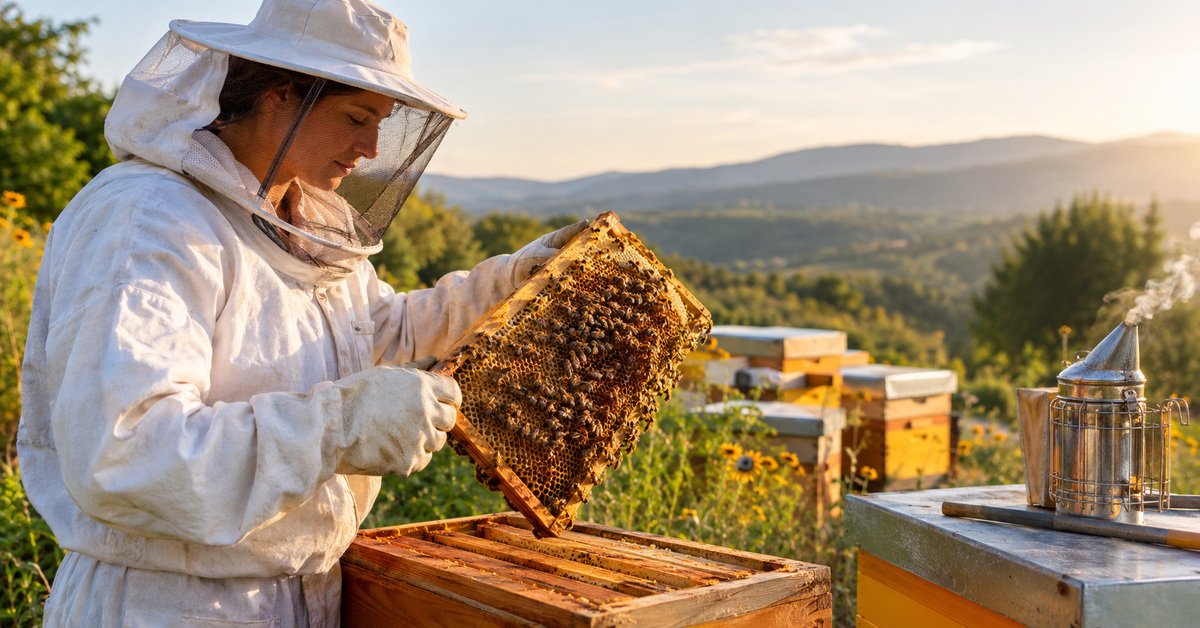
Use a hive tool to break propolis seals before trying to lift a frame by hand. Make space beside the first frame so adjacent comb is less likely to be rolled or crushed. Hold frames above the open box and turn them carefully while keeping the queen’s safety in mind.
Advance when you can loosen, lift, examine, and replace frames calmly, keeping the queen and adjacent bees safe. Stop when weather, bee behavior, or your own coordination makes further manipulation unsafe.
Reading Bee Frames Before Making Colony Decisions
Frame reading connects visible colony evidence to decisions about queens, food, and available space. Look across several frames instead of treating one attractive brood patch as the whole story. Observe the brood nest, adjacent food bands, and the number of frames occupied by bees.
Workers typically arrange brood near the center with pollen and nectar or honey nearby. Fresh eggs suggest that a laying queen was present recently, even when she is not visible. Understanding how a managed colony organizes its work makes these patterns easier to interpret. A missing queen sighting alone is not a reason to introduce a replacement queen.
Compare brood of different ages before concluding that a patchy pattern indicates disease. Temporary brood gaps may follow a nectar shortage, colony disturbance, or a recent queen transition. Unusual larvae, sunken cappings, or unexplained brood mortality deserve local diagnostic advice.
Move from asking what a frame contains to asking what it implies for the next inspection. Record whether brood is expanding, whether food surrounds it, and whether empty drawn cells remain. Watch for signs that bees are backfilling the brood nest with nectar during a strong flow. Take a clear photograph when a mentor needs to help interpret an unfamiliar pattern.
Healthy brood and adequate stores are separate observations that should be checked together. Repeated inspections reveal trends that a single snapshot cannot supply.
Move beyond frame reading when you can explain how brood, stores, and occupied frames justify one sensible next action.
Recognizing Bee Eggs, Larvae, and Capped Brood
Fresh honey bee eggs usually stand upright before tilting as development progresses over subsequent days. Young larvae are small, pale, and curled in the bottoms of open cells. Capped worker brood generally has comparatively flat, tan cappings, while drone brood tends to project outward. Look across multiple cells and stages because light and viewing angle can make identification difficult.
Practice locating eggs on a calm day with the sun behind your shoulder rather than moving frames repeatedly.
Record whether you see eggs, open larvae, and sealed brood instead of declaring the queen healthy on appearance alone.
An even brood pattern can support a favorable assessment but should be interpreted with season and colony history. Scattered brood or abnormal larvae warrant closer examination rather than immediate treatment without diagnosis. Ask for experienced inspection when the pattern is unfamiliar or a regulated brood disease is possible.
Identifying Pollen, Nectar, and Honey in Bee Comb
Stored pollen often appears as densely packed cells with colors varying according to the plants visited. Fresh nectar may glisten in open cells and can spill when a frame is tilted sharply. Ripened honey is commonly sealed under pale or darker wax cappings after bees reduce its moisture. These materials often appear around the brood area, but their distribution changes with forage and population.
Pollen supports brood development by supplying protein and other nutrients to the colony. Nectar and honey provide carbohydrates needed for worker activity and colony heating. Inspect for food distribution across the nest instead of judging from one unusually full frame.
Uncapped cells are not always empty, because clear nectar can be difficult to see. A frame partly filled with nectar provides different immediate value from capped stores ready for a lean interval. Bees can move or consume resources quickly when conditions change outside. Compare several combs and note how far food bands extend around the developing brood.
A good frame assessment includes what the bees have, what they are using, and what may be missing. Take care not to tear food-filled comb while turning or replacing a frame. Practice until you reliably distinguish pollen, uncapped nectar, capped honey, and available empty cells on several frames.
Building a Hive Inspection and Recordkeeping Routine
Start each inspection with a purpose, a suitable weather window, and equipment ready beside the hive. Common questions include whether eggs are present, stores are adequate, and room remains for brood. Keep routine openings efficient, especially when brood could chill or the colony becomes defensive. A written checklist reduces the temptation to pull every frame without a reason.
Record the date, weather, colony identifier, brood stages, food status, and visible disease concerns. Include observed mite counts with the method and approximate bee sample size whenever testing occurs. Distinguish what you actually saw from your interpretation or planned response.
Inspections during a strong spring buildup differ from checks in periods of dearth or cold. Consider the seasonal time commitment of hive care when planning repeatable visits. Leave enough time after the inspection to clean tools, record findings, and arrange follow-up actions.
Use a consistent scale when describing occupied frames rather than simply writing that bees look strong. Photographs can support notes, but written context should explain which hive and frame they show. Compare entries over several visits before making broad conclusions about a colony’s trajectory.
Set a follow-up date that matches the issue observed rather than opening the hive automatically. Urgent food shortages or suspected disease may require faster action than routine growth checks.
Advance when your notes show what changed, why you chose an action, and when you will verify its result.
Learning When a Bee Colony Needs Food or More Space
Judge colony food needs from actual stores, current forage, and the weather expected before the next check. Visible flying bees do not prove nectar is entering the hive in useful quantities. A newly established colony may need support even while nearby mature colonies are storing honey.
Look for pollen and nectar around the brood nest and capped honey in accessible comb. Compare hive weight and stored resources with local seasonal expectations rather than applying one fixed quota. During a forage gap, brood rearing can continue while food reserves decline rapidly. Use feeder types and feeding materials appropriate to local guidance and colony conditions.
Space management requires identifying drawn empty cells, occupied frames, and unused equipment separately. Adding a box too early can leave bees managing more space than they can cover. Waiting too long during a strong flow may restrict storage or brood expansion.
Protect the brood nest while evaluating congestion and honey storage in neighboring frames. If bees have little usable comb but plenty of bare foundation, simply adding more foundation may not solve crowding. Feed only where justified, and avoid placing syrup in equipment intended for a marketable honey crop. When pests or disease are suspected, resolve the health question before relying on feeding as the remedy.
Never assume a full-looking entrance means the colony has resources for the next weather disruption. Use hive records to learn how rapidly food and comb space change at your site. Before moving on, explain a feeding or space decision using observed stores, usable comb, forage, and upcoming weather.
Learning Varroa Testing Before Choosing Hive Treatments
Varroa destructor mites reproduce in capped brood and spread viruses that can seriously weaken honey bee colonies. Learn a repeatable sampling method before selecting a treatment product or calendar date. Visual inspection of adult bees alone commonly misses infestations that matter for colony health.
An alcohol wash or an appropriately performed detergent wash provides a quantitative estimate of mites on adult bees. Sampling around 300 bees allows a direct percentage estimate by dividing the mite count by three. For consistent sampling, the Mann Lake DC671 Varroa EasyCheck Mite Monitoring Tool has a basket marked for measured bee samples. Confirm the queen is absent from the sample, and follow the selected method’s current instructions.
Sample from a suitable brood-area frame and record the date, method, mite count, and colony condition. A result of nine mites from 300 bees corresponds to approximately three mites per 100 sampled bees. Interpret that figure against the colony’s population phase and current regional guidance.
The Honey Bee Health Coalition varroa management resources explain monitoring and selecting controls for North American colonies. Licensed treatments differ in application method, temperature limits, resistance considerations, and honey-super restrictions. Read the complete current product label and comply with rules in your jurisdiction before treatment. Follow-up sampling helps determine whether the intervention reduced the mite population adequately.
Choose management actions from measured risk rather than assuming one treatment suits every season. Even a colony that appears productive can carry a damaging parasite burden. Before choosing treatments independently, demonstrate accurate sampling, percentage calculation, label checks, and follow-up testing with experienced guidance.
Using Seasonal Bee Changes to Plan Hive Work
Honey bee populations respond to forage, daylight, temperature, genetics, and queen performance throughout the year. In temperate regions, spring buildup often precedes a major nectar flow and potential swarming. In warmer climates, rainy and dry periods may define the practical management calendar instead.
Record when major flowering periods begin and when colonies actually start storing surplus nectar. Compare the first season’s common milestones with conditions observed in your own apiary. Expect worker populations and brood area to expand or contract as resources and conditions shift. Avoid applying a temperate winter checklist without considering your location’s actual bee season.
The best moment for adding space depends on colony strength and a likely upcoming forage flow. Preparing for a cold or low-forage interval requires checking stores before they become scarce. Postponing essential parasite management until bees appear weak may miss the most useful intervention window.
Build a local calendar from association advice, weather patterns, flowering notes, and inspection records. Mark tasks that must happen before seasonal transitions rather than after visible problems emerge. Check how any treatment affects feeding, honey collection, and the timing of other interventions. An organized calendar helps you recognize when doing less inside the hive is the wiser choice.
After one full cycle, revise the calendar using what your colonies actually did. Use your developing calendar to anticipate management windows, then revise it when observed flowering or colony conditions differ.
Learning Swarm Signs Before Attempting Swarm Control
Swarming is a natural reproductive process in which the old queen departs with part of the colony. A crowded brood nest, abundant workers, and seasonal conditions can increase the likelihood of swarming. Learn to distinguish swarm preparations from queen replacement and emergency queen rearing.
Inspect brood comb edges and faces for queen cells while assessing the colony’s overall condition. An empty queen cup is not equivalent to a developed queen cell containing a larva. Removing every queen cell without understanding its purpose can leave a colony queenless. Ask a mentor to review the colony before attempting a split or complex swarm-control manipulation.
Adequate room for brood and nectar storage can reduce some crowding pressures but cannot eliminate swarming. A strong nectar flow can rapidly change space requirements even when equipment looked sufficient recently. Your notes should distinguish actual queen-cell development from simple increases in adult bee numbers.
Practice identifying the queen and assessing brood before using manipulations that divide a colony. A split requires suitable bees, brood, food, equipment, and a credible plan for queen establishment. Where bees or swarms must be moved, first check local movement and disease-control requirements.
Swarm prevention begins with observation and timing rather than a single emergency maneuver. Attempt splits only after identifying queen-cell status, checking resources, and discussing the expected queen outcome with a mentor.
Judging Honey Surplus Before Learning to Harvest
A colony can look productive while still needing most of its stored honey for survival. Harvesting decisions should follow an honest assessment of brood, remaining food, and the next forage interval. New colonies may devote their early resources to drawing comb rather than producing removable surplus. Focus first on colony health and reliable assessment instead of setting an arbitrary harvest target.
Identify capped honey and distinguish it from unripe nectar that still contains substantial moisture. Check the relevant food reserve recommendations for your climate before removing any honey frames. The amount a colony needs varies greatly with temperature, forage gaps, and colony population.
Only use extraction equipment that is appropriate for the frame system and hygienically maintained. Keep honey intended for consumption separate from comb exposed to unsuitable feeding or treatments. Check any treatment label for restrictions involving honey supers or harvesting during application. Learn safe lifting and handling before working with heavy honey-filled boxes.
Do not assume uniform honey maturity from the appearance of a single cell patch. Where moisture measurements are needed, use a properly calibrated instrument and appropriate local guidance. Record what was removed and what stores remained so the next decision has a factual baseline.
A missed harvest is preferable to leaving a colony without adequate food during a dearth. Repeated seasons teach which flows produce genuine excess at your particular site. Harvest only when you can document the remaining reserves and explain why selected frames represent a genuine surplus.
Proving Hive Care Skills Before Adding More Colonies
The strongest reason to expand is demonstrated capacity to maintain healthy colonies across changing conditions. Before adding hives, confirm that routine inspections, food assessments, and mite monitoring happen consistently. Review whether you can recognize common problems early and follow through on corrective actions. Growth multiplies the consequences of weak records, poor hygiene, and delayed decisions.
A second colony offers useful comparisons when both receive appropriate attention and documentation. However, additional colonies also increase the demands on lifting, equipment storage, and disease control. Decide how you will handle a failing queen or heavy mite pressure before obtaining more bees.
Assess your ability to recognize when a question exceeds your experience and merits local help. The practical challenges beginners face are often about timely decisions rather than technical complexity alone. A mentor’s observation of your handling can reveal weaknesses that written self-assessment misses.
Track whether your colonies entered the main forage period healthy and emerged with adequate reserves. Document mite results and responses instead of relying on a memory of successful treatments. Consider whether your schedule can absorb urgent inspections during unfavorable weather periods.
Expansion also requires a suitable site, spare parts, clean equipment, and a plan for unexpected colony losses. Check local registration, neighbor considerations, and disease controls before increasing hive density. Learn to separate colonies and tools appropriately when a contagious disease is suspected. Scale only when caring for the current colonies no longer depends on repeated last-minute improvisation.
Before expanding, show records of timely mite checks, adequate stores, consistent inspections, and follow-through on health concerns.
Frequently Asked Questions about the Beekeeping Learning Curve
How many seasons does it take to become a confident beekeeper?
Plan to spend at least one complete local bee season learning routine care before judging your confidence. A second season often reveals patterns that were hard to recognize during the first year. Confidence should mean observing changes, choosing appropriate actions, and checking whether they worked. It should not mean performing every advanced manipulation without seeking help.
Keep separate milestones for frame handling, brood interpretation, food assessment, and mite monitoring. Ask an experienced beekeeper to observe your decisions during different seasonal conditions. Review mistakes in the records without allowing one difficult inspection to define your ability.
Some beekeepers gain reliable practical skills quickly through supervised, frequent fieldwork. Others need several seasons because weather, work schedules, and limited opportunities restrict practice. Judge progress by whether you repeatedly observe, explain, act, and verify results, not by months of hive ownership.
Can I learn practical beekeeping skills without owning a hive?
Yes, you can begin learning through supervised apiary visits, local clubs, and practical training courses. Volunteer sessions allow you to observe frame handling and colony assessment before taking responsibility for bees. Ask whether participants may examine brood and food stores rather than only watching demonstrations. Practice assembling equipment and completing inspection notes with an experienced beekeeper. You are better prepared for ownership when you can schedule care, recognize key comb features, and seek timely help.
Which beekeeping skills should a mentor watch me practice?
Ask a mentor to evaluate protective clothing checks, smoker control, frame removal, and correct frame replacement. They should also watch how you identify eggs, larvae, stores, and signs of disease. Practice explaining what you observed before proposing any management change. This separates careful inspection from an intervention based on assumptions.
A mentor can demonstrate sampling procedures and help you interpret mite results appropriately. Request feedback on when to close a hive instead of continuing a disruptive inspection. Repeat core tasks across supervised visits until you demonstrate controlled handling and sound judgment in different conditions.
How can I learn beekeeping if I struggle to lift heavy hive boxes?
Begin with frame-level inspection skills and arrange help for lifting heavy boxes or supers. Choose equipment dimensions and hive height that match your safe lifting capacity. A stable work area and nearby support surface can reduce unnecessary carrying and awkward bending. Do not work alone when a planned inspection requires handling loads beyond your ability.
Discuss lighter box configurations and compatible frame systems before committing to a hive design. Some accessible setups still require a partner for lifting or emergency relocation. Practice maintaining clear access and closing the hive without placing equipment in unstable positions.
The essential learning outcomes are observation, careful handling, and appropriate colony decisions. Physical adaptations can support those outcomes without making heavy lifting a measure of competence. Seek ergonomic guidance that reflects your own strength, movement, and medical advice when relevant.
How should a beginner handle conflicting advice from experienced beekeepers?
Start by asking which colony conditions and regional assumptions underlie each recommendation. A method suited to a temperate spring may fail during a tropical forage gap. Compare advice with current extension guidance, product labels, and measurable colony observations. Distinguish a beekeeper’s preference from a requirement based on disease control or treatment law. When the evidence remains uncertain, choose the lower-risk action and arrange another assessment.
Record why you selected an approach and what result you expected to observe. Ask advisers which findings would make them change their recommendation next time. That discussion teaches decision-making more effectively than memorizing a favorite method.
Can online beekeeping courses replace practical hive experience?
Online courses can teach bee biology, equipment terminology, and the reasons behind seasonal tasks. They cannot fully reproduce the balance, timing, and restraint needed when handling living frames. Use videos to rehearse what you intend to look for during a supervised inspection. Then compare the lesson’s ideal examples with real comb patterns and colony behavior.
A structured course is especially useful before the first hands-on visit. Local field instruction becomes essential for identifying unfamiliar disease signs and safe management limits. Keep notes on questions that arise only when actual bees behave differently from demonstrations.
When possible, pair each theory topic with an observation that can be checked in the apiary. For example, follow a brood-development lesson by locating eggs, larvae, and capped cells. Review your results afterward with a mentor who knows your local seasons.
The strongest training combines accessible theory with repeated, supervised observation and practice.
Do beekeeping skills transfer between Langstroth and top-bar hives?
Bee biology, brood identification, food assessment, and parasite monitoring transfer between these hive systems. Frame support, comb handling, harvesting, and equipment compatibility require system-specific practice. Unsupported natural comb can be especially vulnerable to breakage during careless movement. Learn the construction and manipulation limits of the chosen hive before transferring familiar techniques.
Does losing a colony mean I lack the skills to keep bees?
No, a colony loss alone cannot identify one cause or measure your overall competence. Varroa, queen problems, inadequate stores, disease, weather, and other stresses can interact. Review inspection records, treatment dates, food observations, and signs found after the loss. Where a regulated disease is suspected, consult the appropriate local inspection service before reusing equipment.
Use the findings to identify a specific skill or monitoring gap worth improving. Some losses occur despite timely care, while others reveal missed opportunities to intervene. A careful post-loss review is more useful than either self-blame or ignoring warning signs.
How can I keep developing beekeeping skills during winter?
During periods when cold weather prevents inspection, review records and prepare equipment for the next active season. Study photographs of brood and stores while checking which observations you previously misunderstood. Attend local training on seasonal management, parasite biology, and disease recognition. Make a short list of skills to practice when conditions permit safe hive openings.
Check external hive conditions without repeatedly disturbing a tightly clustered colony. Where local guidance recommends it, assess food availability through minimally disruptive methods. Avoid copying warm-climate inspection schedules into periods of sustained cold.
Use winter preparation to clean approved equipment and organize inspection supplies. Compare the previous year’s flowering and mite records with the next season’s likely demands. An organized plan can improve decision speed when spring conditions change quickly.
What is the difference between beekeeping certification and practical competence?
Certification demonstrates that a beekeeper has met the requirements of a particular training or assessment program. Programs vary in the depth of theory, field observation, and supervised practical testing they include. Practical competence means performing safe, timely colony care and recognizing when expert assistance is needed. Neither a certificate nor years of ownership automatically proves that every management skill is reliable.
Choose training that includes actual brood assessment, safe manipulation, and parasite monitoring where possible. Ask whether examinations test field judgment or mainly recall of facts. Compare the program’s expectations with regulations and disease risks in your location.
Continue documenting decisions and outcomes after any course or examination has ended. Seek feedback from another experienced beekeeper when your observations are uncertain. Remaining open to correction is an important element of responsible colony care.
The useful goal is demonstrated skill supported by continuing observation, education, and evidence.
What to Remember About the Beekeeping Learning Curve
Build confidence by progressing from bee biology and controlled handling to frame interpretation, records, and evidence-based colony decisions. Practice measuring mites and judging food or space before tackling swarm control, harvesting, or expansion. Use local extension advice and a mentor whenever unfamiliar conditions exceed what your observations can support.
Before your next inspection, choose one skill, identify what evidence proves it, and arrange feedback on your decision. Repeat that process through changing seasons until sound decisions become a dependable habit.