
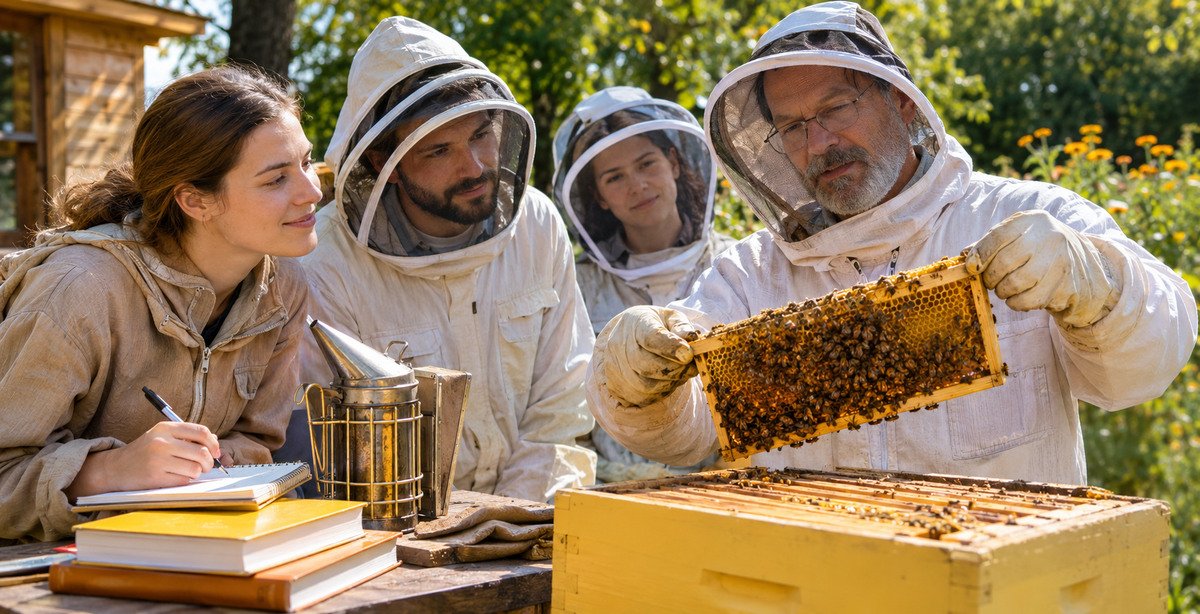
Learning how to learn beekeeping starts with watching a beekeeper open a living colony, not memorizing equipment names. Classes explain what you might see, but real hive inspections teach you how quickly conditions can change. A mentor helps distinguish an ordinary brood pattern from a problem that requires follow-up. The strongest beginner pathway combines instruction, observation, supervised practice, and reliable field notes.
Before buying bees, decide which practical skills you must demonstrate and which local questions remain unanswered. Before purchasing equipment, use a first-year beekeeping plan to connect lessons with colony-care decisions.
Start with bee biology, safe handling, basic inspections, colony nutrition, and pest-monitoring principles. Choose courses whose examples resemble your climate, honey bee population, and the management system you expect to use. Then ask an experienced local beekeeper to check your observations before you act on them.
You can progress without owning a hive immediately by attending demonstrations and volunteering at supervised apiaries. Keep a notebook of what you saw, what the instructor did, and why that action fitted the season. Review the notes after each visit and identify one skill for the next session.
Jump to a specific section on this article
Contents
Which Beekeeping Skills Should You Learn First?
Begin with colony organization so that every inspection has a clear purpose. Learn the roles of workers, drones, and the queen before trying to interpret comb. Recognize eggs, larvae, capped brood, pollen, nectar, and stored honey in photographs first. Then compare those patterns during a supervised inspection, where lighting and movement make identification harder.
Practice approaching from the side or rear without obstructing the main flight path. Ask an instructor to demonstrate calm frame removal and how to avoid crushing bees. Observe how weather, forage availability, and colony temperament influence decisions about opening a hive.
Before managing bees independently, understand the difference between signs and diagnoses. Study a colony-care overview to organize inspections around bee health rather than honey extraction. Learn why an apparently active entrance does not establish colony health.
Add protective clothing checks, smoke management, and tool hygiene to your essential skills. Understand sting reactions and discuss an emergency response plan with the training provider. Learn that visual checks for mites cannot replace an appropriate sampling method. Treat medication choice and timing as locally regulated decisions requiring current, relevant guidance.
Finally, practice describing what you see without immediately proposing an intervention. Record visible evidence before asking whether a colony needs feeding, more space, or further assessment. A reliable beginner can explain both an observation and its remaining uncertainty.
Choosing Beekeeping Classes With Practical Sessions
Compare courses by their supervised hive time, not just the length of classroom presentations. Ask whether every student handles a frame or watches an instructor perform the entire inspection. A useful class should demonstrate brood recognition, safe frame handling, and a basic colony-health assessment. Confirm the student-to-instructor arrangement before booking so practical feedback will be available.
Request a written syllabus covering colony biology, inspection technique, swarm awareness, nutrition, and pest monitoring. Ask which lessons are classroom demonstrations and which involve actual colonies. Choose instructors who explain local flowering seasons, permitted treatments, and differences between hive systems.
Consider the physical demands before selecting an in-person course. Handling hive boxes, standing outdoors, and working near flying bees require suitable preparation. Tell the instructor about mobility or accessibility needs before booking a session. A responsible provider should explain observation-only options when active participation is unsuitable.
Look for a sequence of demonstration, assisted handling, and a final observed practice inspection. Ask what evidence instructors use before feeding, adding space, or postponing a hive opening. Prefer teachers who explain their choices aloud and invite students to question assumptions.
After class, list three operations you completed yourself and one mistake your instructor corrected. Use that list to request targeted practice rather than repeating an entire introductory lecture.
Making the Most of Online Beekeeping Courses
Use online lessons to study anatomy, inspection objectives, seasonal changes, and examples of healthy brood. Pause each module to describe the evidence before the presenter explains an intervention. Pair video learning with local apiary visits because a screen cannot teach frame weight or bee movement.
Build a lesson notebook with a question, an expected observation, and the instructor’s explanation. For brood recognition, sketch the difference between eggs, larvae, capped worker cells, and drone brood. For pest monitoring, record the demonstrated sampling method rather than copying a treatment schedule. Review confusing moments with a mentor before applying an online technique to live bees.
The University of Arkansas Extension offers a complete online beekeeping short course taught by apiculture specialist Jon Zawislak. Its seventeen instructional parts cover hive equipment, bee biology, seasonal management, regulations, and colony health. Treat those modules as foundational study, then confirm local conditions with nearby practitioners.
Be cautious when videos show treatments or feeding schedules without location and date. Product labels, local regulations, honey flows, and seasonal temperatures can alter what is appropriate. Write down the climate and colony conditions assumed by the instructor. Seek current regional extension guidance before repeating a specific management action.
Before each field visit, review one relevant lesson and write down two questions to test outdoors. Afterward, compare the video demonstration with the actual colony observations in your notes.
Use remote courses to prepare decisions, and supervised practice to test your handling skills.
Finding a Beekeeping Mentor Who Explains Field Decisions
Find potential mentors through local beekeeping associations, extension educators, or established training apiaries. Ask whether they manage the same hive type and forage conditions you expect to encounter. A useful mentor explains the observations supporting each decision rather than handing out fixed instructions. Choose someone comfortable discussing errors, disease concerns, and situations requiring specialist advice.
Request one observation visit before agreeing to a longer mentoring arrangement. Ask about availability during the active season, practical handling opportunities, and urgent-contact expectations. Agree on protective equipment, apiary access, photography rules, and how feedback will be recorded.
At the first visit, ask your mentor to demonstrate an entire inspection and narrate their reasoning. During the second suitable session, repeat a limited task while they supervise your technique. Finish by naming the strongest evidence you observed and one uncertainty for follow-up.
Good mentors also demonstrate when not to open a colony. They should explain whether a concern needs monitoring, immediate action, or specialist advice. Maintain respectful boundaries when requesting help between scheduled visits.
Evaluate a mentor by the quality of specific feedback, not by confident claims or impressive honey yields. Ask what you must demonstrate independently before they would trust you to inspect without guidance.
Keep a dated record of mentor feedback and revisit unresolved observations during the next supervised session.
Choosing Beekeeping Books for Your Climate and Hive
For an illustrated beginner introduction, consider Kim Flottum’s The Backyard Beekeeper, fifth edition, published in 2024. For stepwise colony procedures, Diana Sammataro and Alphonse Avitabile’s The Beekeeper’s Handbook, fifth edition, offers detailed diagrams. Check each book’s hive system and regional assumptions against your planned local apiary.
Malcolm Sanford and Richard Bonney’s Storey’s Guide to Keeping Honey Bees, second edition, covers hive setup, colony nutrition, and pests. Start with one accessible book and use a second when it answers a specific practical question. Before visiting the apiary, sketch a frame and label the stages or stores you expect to recognize. Compare those diagrams with actual comb under supervision rather than assuming illustrations capture every variation.
Books written for temperate climates may describe spring buildup and winter preparations that differ from your region. In tropical areas, rainfall and forage gaps can be more useful planning cues than calendar months. Ask a local mentor to translate seasonal advice into observations and decisions for your bees.
Use the handbook’s inspection illustrations to rehearse an opening sequence without live bees. Practice naming the evidence that separates young brood, capped food, and suspicious comb. Flag treatment guidance for a current regulatory check because approved products and labels may change. Write down chapter references beside field notes so you can locate answers after each session.
When terminology becomes confusing, compare early beekeeping challenges with the diagrams in your chosen reference. Favor clearly illustrated procedures over collecting several books with overlapping introductory chapters. Borrow or preview additional titles before committing to more advanced material.
Learning From Local Apiaries and Beekeeping Clubs
To find a local group, ask an agricultural extension office, training apiary, or established beekeeper for contacts. Attend a meeting before acquiring bees and ask when supervised beginner visits are scheduled. Choose associations that discuss local pests, forage patterns, and practical training rather than honey yields alone.
At an apiary visit, ask to observe a complete inspection rather than only the most interesting frame. Watch how the host approaches flight paths, manages equipment, and replaces comb without crushing bees. Ask which tasks depend on the local hive system and which principles transfer between systems. Record one method you could safely practice later with a supervising beekeeper.
Regional experience helps interpret unusual weather and forage gaps. Compare several members’ observations before assuming a single colony represents the district. If advice differs, ask what evidence would resolve the disagreement.
Volunteer for suitable tasks such as checking empty hive components, maintaining records, or organizing protective gear. Ask whether the club matches newer members with named mentors or runs supervised inspection days. Use a first beekeeping season overview to connect club demonstrations with actual colony development. Record the association’s next practical session and the person responsible for arranging access.
Ask the host about protective clothing, observation boundaries, and the procedure for a sting emergency. Do not bring unfamiliar tools or medication into someone else’s apiary without express permission. After each visit, confirm what you may practice next and when a mentor will supervise.
Turning Beekeeping Lessons Into Supervised Hive Practice
Use a four-stage sequence: observe, assist, perform, and explain the inspection decisions. First watch a mentor demonstrate the task while naming the evidence they seek. Then repeat only one operation under supervision before progressing to a complete inspection.
Before opening, state the question you hope to answer and check that weather permits inspection. Confirm veil closures, gloves, footwear, and any host-specific rules before approaching the hive. Practice positioning a smoker and hive tool on an empty setup before handling bees. With your mentor beside you, open the colony gradually and keep exposed comb protected.
Identify brood stages and food stores before deciding whether anything needs changing. Say what you see aloud, allowing the mentor to correct uncertain descriptions. Protect the queen and return frames carefully rather than rushing toward an intervention.
Practice separating a propolis-sealed frame using a properly fitting hive tool. Keep both hands ready to support the frame as it lifts vertically from the box. Ask the mentor to show where to rest equipment without blocking entrance traffic. If the colony becomes difficult to handle, follow the mentor’s instruction to close safely.
At the end, compare your inspection purpose with the evidence you actually collected. Choose one skill to repeat at the next suitable supervised session.
Practicing Bee Handling and Inspections With a Mentor
Before approaching the hive, name the inspection question, expected observations, and stopping conditions. Ask your mentor to demonstrate loosening a frame and keeping it stable over the box. Practice maintaining a clear grip without placing fingers where bees may be crushed. Explain aloud why you return each frame to its original position.
Begin by handling one frame cleanly before attempting an entire colony inspection.
When uncertain about queen location or frame orientation, stop and request immediate mentor guidance.
Practice lighting a smoker away from live bees, with the mentor checking fuel and airflow. Learn to apply modest smoke only where needed and avoid directing hot equipment toward people. Rehearse safe shutdown and placement before relying on the smoker during an inspection.
Recording Beekeeping Observations for Mentor Feedback
Use one entry per colony visit with the date, weather, hive identifier, and inspection objective. Record eggs, young larvae, capped brood, pollen, nectar, and visible stores separately when observed. Note which frames were examined and whether the queen was seen or only fresh eggs. Mark uncertain findings clearly rather than forcing a diagnosis from a brief glance.
Record what your mentor decided, the supporting evidence, and any agreed follow-up observation. Keep interventions distinct from observations so later changes can be interpreted accurately. Ask permission before taking photographs and avoid prolonging exposure for documentation.
At the end of each visit, compare your record against the mentor’s independent observations. Ask them to check one description of brood and one judgment about food stores. Where the two assessments disagree, note precisely which visual clue you missed. Write down the next decision trigger rather than simply planning another routine inspection.
At your next session, compare the new observations with the previous colony record. Bring unresolved questions so the mentor can assess how your reasoning has developed. Accurate notes become a practical tool for spotting patterns, not just documenting attendance.
How to Learn Beekeeping Through a Seasonal Practice Plan
Use a six-week preparation plan as a practical starting framework, then adapt it to local colony conditions. During week one, learn basic bee biology and label brood stages using photographs or diagrams. During week two, study safety procedures, hive components, and the purpose of inspections.
In week three, attend a hands-on class and observe an entire inspection from preparation through closing. In week four, ask a mentor to supervise frame lifting and identification of brood and food stores. During week five, record a second guided inspection and compare the findings with your earlier notes. Use week six for a supervised practice assessment and a list of skills needing further work.
Continue learning through the local active season because a six-week introduction cannot show every colony condition. During colony buildup, concentrate on changing brood patterns, space use, and reliable pest monitoring. During forage shortages or adverse weather, learn when feeding decisions or postponed inspections require local advice.
Plan follow-up visits around meaningful colony changes rather than an arbitrary weekly opening schedule. As forage and weather change, the annual beekeeping workload may include urgent colony-health checks. Keep flexible time for returning to a mentor when observations require confirmation.
At each milestone, record the action you performed independently and the feedback received. Delay new responsibilities until you can repeat the prerequisite skill safely in suitable conditions.
What to Do When Beekeeping Advice Conflicts
When two beekeepers disagree, write down the exact decision and conditions behind each recommendation. Separate disagreements about hive style from those concerning colony health or legally controlled treatments. Ask what brood, food, pest, temperature, or forage evidence would support each proposed action. A decision rule tied to observations is more useful than choosing whichever adviser sounds most confident.
Compare the claims with your inspection notes and current agricultural extension guidance. Ask which parts are established biology and which represent local experience or preference. If the advice still conflicts, request a supervised review before making a consequential intervention.
For mite concerns, agree on the appropriate sampling method before discussing a treatment choice. Record the sample size, timing, colony conditions, and result rather than describing mites as simply present. Check the current label and legal requirements for the exact locally permitted treatment. Do not copy an internet dose or apply a treatment because another hive required one.
Document the evidence, decision, mentor’s reasoning, and date for the next check. When an observation suggests an urgent health problem, contact a qualified local adviser promptly. Keep alternative explanations in the record until a later observation resolves them.
Changes in climate and forage can explain different management calendars without changing fundamental bee biology. An effective mentor can distinguish local adaptations from practices that lack supporting evidence. Revise your original plan when direct observations or stronger guidance justify a change.
Are You Ready to Keep Bees Without Supervision?
Before working alone, demonstrate an inspection from safety preparation through calm frame replacement. Identify eggs, larvae, capped brood, pollen, and stored food without relying on guesswork. Explain what an unexpected pattern might mean and when you would request additional evidence. Describe a current pest-monitoring approach and where to find locally applicable intervention guidance.
Ask your mentor to observe one complete inspection while intervening only when safety or colony welfare requires it. Compare the record you produce with their independent findings immediately afterward. Repeat any missed competency during a later suitable visit rather than accepting a vague approval.
Confirm that you understand local apiary registration, placement requirements, and access responsibilities. Check protective clothing fit, suitable water provision, and a realistic response plan for stings. Identify a reliable person to contact when an unfamiliar problem appears between lessons.
Test yourself with a scenario involving reduced stores, ambiguous brood, or an unexpected queen cell. Describe what you would observe next before recommending an irreversible intervention. Explain when weather, colony behavior, or your uncertainty should end the inspection.
Arrange continuing advice even after the mentor confirms basic handling and observation skills. Keep a season-specific record of forage shifts, colony strength, and pest monitoring results. Recheck hive equipment compatibility before using a technique demonstrated on a different system. Treat every unexpected result as a reason to reassess evidence rather than automatically repeating the previous action.
Begin independent beekeeping only when practical skills, local support, safe access, and realistic availability are established.
Frequently Asked Questions about How to Learn Beekeeping
How Can I Learn Beekeeping If I Cannot Keep Hives at Home?
You can learn substantial beekeeping skills without keeping colonies on your property. Begin with a structured class and request supervised observation at a local teaching apiary. Practice identifying brood stages using reputable photographs and annotated training materials. Keep a field notebook so each visit builds on the previous one.
Ask a club whether members host beginner-friendly field sessions. Some apiaries offer observation days but restrict handling to registered trainees. Respect those restrictions because responsibility for colony welfare remains with the host.
Use online lessons to review questions raised during each visit. Practice handling empty equipment only when its owner permits and it is safe. Postpone acquiring bees until you have suitable accommodation and ongoing support.
How Much Time Should I Reserve for Beekeeping Lessons and Mentoring?
For an eight-week beginner preparation plan, reserve one or two hours weekly for structured study. Arrange several supervised apiary visits during suitable weather, rather than assuming one demonstration is sufficient. Use the first visits for observation and basic frame handling before requesting a complete practice inspection. Ask your mentor to schedule follow-up sessions when brood development or forage conditions change. Adjust the timetable to local seasonality and repeat any skills you cannot yet demonstrate safely.
What Should I Bring to My First Practical Beekeeping Class?
Bring the protective clothing, closed footwear, and documents specified by your instructor. Ask in advance whether the host supplies a veil and gloves. Carry a notebook, drinking water, and any required personal safety information. Avoid strong fragrances and loose accessories that could interfere with protective clothing.
Do not bring unfamiliar tools into the teaching apiary without prior approval. Inspect clothing closures before approaching the colony and follow the instructor’s entry rules. Keep phones and recording devices out of the way during close handling.
Can Children Take Part in Practical Beekeeping Lessons?
Children can sometimes observe supervised demonstrations when the provider explicitly permits their age group. Ask about age rules, guardian supervision, and the boundaries of the observation area. Confirm that correctly fitted protective clothing is available for every participant. Discuss sting-response arrangements with the organizer before attending.
A child should never be expected to manage a colony independently. Begin with viewing equipment and pictures before considering proximity to live bees. Stop the activity when the child becomes distressed or cannot follow safety instructions.
Providers may offer child-focused sessions with shorter demonstrations and additional supervision. Ask whether any practical handling is permitted and who remains responsible. Choose the child’s comfort and safety over completing a particular lesson.
Should I Buy Beekeeping Equipment Before Starting a Course?
Usually, wait until your instructor confirms which equipment you actually need. Different hive systems may use frames and boxes that are not interchangeable. A class can reveal whether your gloves and veil fit correctly. Borrowed demonstration equipment can help you learn basic handling before purchasing anything. Confirm local inspection practices and the intended hive configuration before choosing tools.
If you already own equipment, bring its specifications rather than assuming compatibility. Ask your mentor to identify which items are essential for supervised sessions. Delay specialized accessories until practical experience explains their purpose.
How Can I Manage Fear of Bees During Beekeeping Lessons?
Begin with a classroom explanation and a distant observation before attempting hive handling. Tell the instructor which situations make you uncomfortable and agree on a clear stopping signal. Use properly fitted protective clothing and remain within the supervised visitor area. Do not force direct contact simply to meet a course timetable.
Watching calm, predictable movements can make the activity easier to understand. Ask the instructor to explain bee behavior without promising that stings cannot happen. Practice positioning and handling empty equipment away from flying bees.
If anxiety interrupts concentration, return to observation rather than opening a hive. Discuss a slower learning sequence with the training provider before another practical session. Anyone with a known serious sting allergy should address exposure planning with an appropriate medical professional.
Progress is useful only when you can follow safety instructions consistently.
What Can I Practice When Weather Cancels a Beekeeping Session?
Use cancelled field time to practice arranging protective clothing and handling empty frames in the correct order. Review photographs of eggs, larvae, capped brood, and stored food, then check your identifications. Write a mock inspection report that separates observations, possible explanations, and questions for your mentor. Reschedule live handling for suitable weather rather than attempting to replace supervision with videos.
Can Two Beginners Share a Beehive While Learning Beekeeping?
Two beginners can share a colony when one clear management plan assigns responsibility. Agree who records inspections, monitors pests, and contacts the mentor about urgent changes. Schedule joint lessons so both trainees observe the same decisions. Avoid competing interventions based on separate, unverified advice.
Each person should practice the essential tasks under supervision. Keep one consistent inspection log and record who performed each action. Clarify equipment ownership and colony-care responsibilities before acquiring bees.
How Can I Fit Practical Beekeeping Lessons Around a Full-Time Job?
Choose a course with self-paced theory and field visits scheduled during locally suitable hive conditions. Set aside regular short study periods and reserve several flexible opportunities for supervised inspections. Ask a mentor whether early or weekend sessions are practical without compromising colony care. Use a shared calendar to track local seasonal events and your required follow-up checks.
Bee management cannot always fit neatly around a predictable employment schedule. Before obtaining bees, arrange reliable help for urgent observations or tasks you cannot attend. Do not equate completing online lessons with being available to manage a live colony.
After a missed visit, review the mentor’s records and schedule another practical opportunity when conditions permit. Continue logging what you personally observed rather than copying another beekeeper’s conclusions as your own. Reconsider colony ownership until consistent access and emergency support are realistic.
Can I Learn at an Apiary That Uses a Different Hive Type From Mine?
Yes, many observational and handling skills transfer between hive systems. Colony biology, basic pest monitoring, and safe approach principles remain relevant. However, frame dimensions, inspection access, and methods of adding space can differ. Ask the instructor which procedures depend on the particular equipment.
Use the host’s system as an opportunity to observe its practical trade-offs. Do not assume a frame lifter, feeder, or spare part will fit your equipment. Request a separate lesson on the layout and components you intend to manage.
Record which principles are shared and which operations need adaptation. Review your own hive manufacturer’s specifications before applying unfamiliar equipment instructions. Arrange at least one supervised session with your intended hive system.
Your learning transfers best when you can explain why the procedure changes.
A Few Last Things to Know About How to Learn Beekeeping
Learning beekeeping effectively means pairing structured courses and reliable books with supervised inspections and deliberate reflection. Begin with bee biology and safety, then practice frame handling, observation, and recordkeeping with a mentor. Measure progress by what you can demonstrate and explain, rather than by course certificates alone.
Start by identifying a local class or club that offers supervised time with managed colonies. Use a focused six-week preparation plan, then continue learning across changing forage and brood conditions. Seek an independent readiness assessment before acquiring bees, and keep dependable local support afterward.