
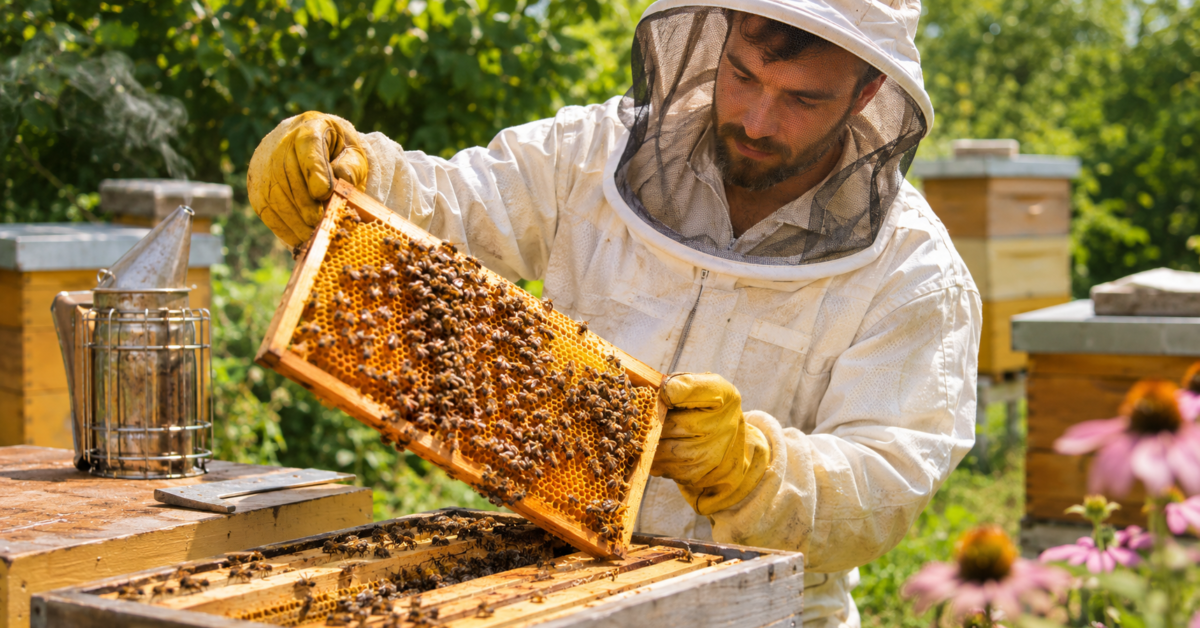
What is a beekeeper called besides a beekeeper? The established alternatives are apiarist and apiculturist, terms for people who manage bee colonies. Those names describe the work, not a degree, license, or minimum hive count. Specialists use more precise titles when they raise queens, supply pollination, inspect apiaries, or conduct research.
In a club introduction, beekeeper is clear; an agricultural report may favor apiarist. When requesting help, the person’s experience with your actual problem matters more than their label.
An apiary is where colonies are kept, while apiculture is the practice of keeping them. Neither term names a beekeeper’s rank or guarantees professional credentials. Confusing place, practice, and occupation leads to misleading searches and job descriptions.
Below, the terms are grouped by everyday identity, business activity, specialist work, and credentials. You’ll also learn why a honey seller or insect scientist may not personally keep bees. Start with beekeeper or apiarist, and add a specialty only when the person’s duties justify it.
Jump to a specific section on this article
Beekeeper, Apiarist, and Apiculturist: What Is a Beekeeper Called?
Beekeeper is the clearest everyday English title for a person who maintains bee colonies. Apiarist is a synonym often seen in association names and agricultural documents. Apiculturist describes someone practicing apiculture and can sound more technical. None of these terms by itself establishes competence, commercial status, or training.
If someone owns bees but hires another person for every inspection, beekeeper may obscure who provides care. The person managing the bees can still accurately use that title. Ask who actually inspects and makes decisions when the distinction matters.
Introduce a hobbyist to neighbors as a beekeeper rather than using unfamiliar jargon. In a technical report, apiarist may provide the conventional vocabulary. On a business card, adding queen rearer or pollination contractor explains the actual service.
Unlike a designated inspector, an apiarist is not inherently a regulated professional title. Routine managing honey bee colonies means observing brood, assessing food stores, and responding to conditions. Someone may perform this work without ever selling honey. For legal qualifications, verify local requirements rather than trusting the occupational label alone.
When asked for your occupation, start with the word your audience recognizes. Specify volunteer, commercial, or queen-rearing work only when those details apply. A precise two-word description usually tells readers more than choosing a formal-sounding synonym.
Apiary and Apiculture: The Place and the Practice
Apiary means a location with one or more managed colonies, often called a bee yard. A hive is the colony’s physical housing, not a synonym for the entire site. Apiculture names the keeping and management of bees. An apiarist works at an apiary while practicing apiculture, keeping all three terms distinct.
One beekeeper may work at multiple apiaries with different forage, access, and weather conditions. Those differences affect inspections, transport, and disease prevention. Several apiary sites do not necessarily imply a large commercial business.
Beekeeping and apiculture describe the same field in ordinary usage. Within an apiary, the work includes seasonal colony management, pest surveillance, queen assessment, and food-store monitoring. Honey harvesting is optional rather than a defining duty. For some apiaries, pollination contracts or queen production are the primary goal.
Registration paperwork may identify the apiary address separately from the beekeeper’s contact information. Disease-control rules can assign obligations to owners, operators, or particular sites. Correctly identifying each one helps prevent confusion during inspections or colony movements.
Think of apiary as the place, apiculture as the activity, and apiarist as the person. The same vocabulary works for one hive or many.
Hobbyist, Sideliner, and Commercial Beekeeper Labels
Hobbyist beekeeper generally describes someone who keeps colonies mainly for personal interest or enjoyment. A sideliner combines beekeeping activity with another principal livelihood or substantial occupation. Commercial beekeeper usually signals that bee-related services or products form a primary business.
Some educational sources use hive counts as convenient teaching categories. In a Florida extension project, hobbyists are grouped at forty colonies or fewer. Its sideliner category spans forty-one through one hundred colonies, while commercial operators are described as having one hundred or more. These illustrative categories overlap at one hundred, so they should not be treated as universal legal thresholds.
Income source and responsibility often distinguish these groups more meaningfully than raw hive numbers. A hobbyist may keep detailed records and mentor others. A commercial operator might assign different people to queen rearing, feeding, transportation, and disease monitoring.
Judge experience by work performed, not by labels on a website. Even keeping a single hive involves recognizing brood problems, watching mite pressure, and checking food reserves. Larger operations add scheduling and supervision, but employees may specialize in different tasks. Ask what someone personally handles before relying on their advice.
Registration, zoning, and tax obligations can depend on location and business activities. Check the applicable authority rather than using hobbyist as a regulatory exemption.
Say whether someone keeps bees for recreation, supplementary income, or a primary livelihood when that distinction matters.
Bee Farmer, Honey Producer, and Honey Seller Compared
Bee farmer is an informal agricultural description for someone raising managed bees. Honey producer is narrower, describing the source of honey rather than every beekeeper’s work. A pollination contractor may care for many colonies without primarily selling honey. Conversely, honey retailers may never inspect a hive or own bees.
Honey sellers may purchase packaged honey from independent producers or distributors. Their business activity does not establish that they inspect hives or manage bee health. Ask whether the seller keeps the colonies behind the product if origin matters.
A keeper harvesting honey from personally managed hives is both beekeeper and honey producer. A packing company can buy honey from multiple apiaries and sell it under one label. Packaging expertise is valuable, but it does not itself establish colony-management experience.
When a buyer asks about queen origin or treatment history, only a knowledgeable source can answer reliably. Retail staff may know labeling requirements but not conditions inside supplying colonies. The safest terminology describes the actual task, not an assumed chain of production.
Ask a honey merchant who owns the bees, who harvests, and who packs the product. Those separate answers explain traceability more clearly than the word beekeeper alone.
If the person only buys and resells honey, honey merchant is more accurate than beekeeper.
Queen Rearer and Bee Breeder as Specialist Beekeepers
Queen rearer means someone who produces queens for replacement, introduction, or sale. Bee breeder describes a person choosing breeding stock for measurable inherited traits. One beekeeper may perform both jobs, but the terms describe different objectives.
Queen rearers coordinate queen-cell production with suitable mating opportunities. Breeders track parentage and performance to make repeatable selection decisions. Temperament, hygienic behavior, and winter survival require defined observation methods. A label such as gentle stock is not meaningful without knowing the evidence behind it.
Rearers may supply mated or unmated queens, queen cells, or small colonies containing new queens. These are different biological and handling stages, not interchangeable products. Buyers should ask what stage is supplied and how acceptance will be assessed.
Raising a healthy queen does not demonstrate that her offspring inherit a target trait. Controlled mating or documented mating areas make breeding claims more interpretable. Performance across several colonies and seasons is stronger evidence than one impressive hive. Ask breeders which traits they actually measured and how they limited environmental effects.
Queen rearing is about producing usable queens on a reliable schedule. Bee breeding adds planned selection among parents and descendants. The role can still be called beekeeper when the person directly manages living colonies.
Queen Rearer: Producing and Introducing Honey Bee Queens
Queen rearers raise developing queens in colonies prepared to feed and protect queen cells. A cell can be damaged by poor temperature control or rough handling. Newly emerged queens need suitable mating weather and drone populations. A rearer generally checks that a queen is laying before describing her as established.
A batch record should connect cell origin, mating date, and laying status to each individual queen.
Weather, forage, and local drone availability determine when queen production is practical.
A queen rearer may specialize in supplying replacement queens during local seasonal windows. A breeder may sell queens too, but the production title makes no claims about genetic selection. Ask for exact queen status, shipping conditions, and introduction steps before planning a replacement.
Bee Breeder: Selecting Traits Through Colony Records
Breeders define an objective, such as hygienic response, before selecting candidate colonies. Recorded observations must use consistent methods and dates. Compare colonies under similar conditions to avoid mistaking favorable forage for inherited performance. Open mating makes paternal ancestry uncertain unless the breeding scheme addresses it.
Selection decisions work best with records across many colonies, not one high-performing queen. A useful record identifies the method, season, and comparison group. Claims of mite resistance require careful interpretation because resistance and tolerance are not identical.
Standardized hygienic-behavior assays provide one way to compare some colony responses. Assays do not prove that Varroa monitoring or treatment can safely be abandoned. Breeding outcomes also depend on mating success and environmental pressures. Ask what was actually measured rather than accepting broad phrases such as disease-proof.
Traceable breeding records help buyers evaluate a strain’s documented characteristics. Bee breeder is the precise label when selection and mating decisions guide reproduction. Queen rearer is enough when the operator produces queens without a documented breeding program.
Pollination Beekeeper: Managing Colonies for Crop Services
A pollination beekeeper supplies managed colonies to farms during crop bloom. Hives may be placed near orchards, seed crops, or fields requiring insect visitation. The work combines colony husbandry with agricultural scheduling and transport.
Bloom dates set narrow windows for moving colonies into position. Beekeepers need to assess adult bee populations, brood, food reserves, and pests. Growers should clarify where hives stand and how field operations affect them. Contracts can specify colony-strength checks, delivery, access, removal, and communication about pesticide applications.
Pollination contracts pay for a service, not necessarily the honey those colonies produce. Moving colonies may increase stress, labor, and opportunities for disease spread. Coordination with growers on pesticide timing is therefore operationally important.
Early bloom can arrive before colonies reach their strongest populations. As seasonal beekeeping workload changes, pollination operations add loading, transport checks, and communication with growers. Hive counts alone do not indicate whether a contractor can meet a crop’s demand. Colony condition and delivery reliability are more informative measures.
Ask a pollination beekeeper how colony strength is assessed before delivery. Also ask how weak colonies, spray warnings, and post-contract retrieval are handled. Those answers distinguish service expertise from simply owning large numbers of hives.
Apiary Manager and Apiary Inspector: Operations Versus Oversight
An apiary manager runs the practical operations of one bee yard or an entire business. An apiary inspector checks colonies for specified pests, diseases, or compliance issues. Both may open hives, but their authority and reporting obligations differ.
Managers organize staff, equipment maintenance, feeding decisions, and queen replacement. They track colony losses and plan how sites are used through the season. Government inspectors may have powers defined by legislation and agency procedures. A private consultant cannot assume those powers merely by using the title inspector.
University of Florida’s beekeeping glossary defines an apiary inspector as a state-designated official checking colonies for diseases and enforcing rules. In other places, inspection authority follows different local statutes and departments. Confirm the inspecting body’s jurisdiction and remit before assuming a visit satisfies official obligations.
An operations manager makes decisions for the beekeeper or business operating the colonies. A regulator records findings and may order action under applicable law. A paid adviser can inspect condition without issuing an official certificate. Ask whether a report is for management, insurance, movement control, or legal compliance.
Before hiring an inspector, specify whether you need technical diagnosis or official certification. Request the relevant authorization and expected written findings.
Beekeeper Versus Entomologist and Bee Researcher
An entomologist studies insects, not specifically someone who keeps bees. A bee researcher studies questions about bees through experiments or observations. Both may work with wild species, managed colonies, or laboratory specimens.
An entomologist might study bee pathogens or the effects of pesticides. A field ecologist could track wild bee nesting without ever opening a managed hive. Some laboratory researchers analyze DNA, pollen, or disease samples instead of handling colonies. Thus scientific expertise and practical apiary experience overlap, but neither proves the other.
A university researcher who tends experimental colonies is both researcher and beekeeper. Experienced keepers also contribute valuable observations to citizen-science or extension projects. Neither activity alone demonstrates expertise in every bee species or management problem.
If your concern is Varroa in a managed hive, seek someone experienced with honey bee health. For a native bee identification question, an entomologist may be better qualified. Choose by the problem and the person’s demonstrated knowledge rather than their broad job title.
Beekeeper describes stewardship of managed colonies; researcher identifies a scientific role. One person can accurately hold both titles when the roles overlap.
Volunteer and Apprentice Titles in Beekeeping
A volunteer beekeeper helps in an apiary or education program without necessarily owning colonies. An apprentice learns tasks under supervision or within a structured course. Neither label automatically means the person can make independent treatment or inspection decisions. Clear supervision protects trainees and the colonies they handle.
Volunteers might prepare frames, maintain water stations, or record observations. Hive entry requires suitable supervision and protective equipment. A volunteer’s title does not reveal whether they have ever handled brood frames or queens.
Apprentices should practice identifying eggs, brood patterns, food stores, and pest symptoms. For new learners, a practical first-year beekeeping plan connects these observations with seasonal tasks. Structured programs sometimes require logs and assessments, but requirements vary among providers. Completing an apprenticeship does not automatically grant official inspection authority.
Before a training inspection, agree who will open the hive and who records findings. Trainees also need a clear process for reporting suspected disease. Good mentors explain what an observation shows before suggesting intervention.
Volunteers may be highly experienced keepers who simply donate their time. Apprentices may own bees but still be learning specialist procedures. Naming the training or service role alongside beekeeper gives the most accurate description.
Master Beekeeper and Other Credentials: What the Titles Mean
Master Beekeeper is a title granted through particular education or certification programs. It is not an automatically regulated profession across the English-speaking world. Programs can assess knowledge, field practice, teaching, or community service. The issuing body’s published criteria determine what its credential actually demonstrates.
Certificates confirm that an individual met the issuing program’s stated requirements. They do not replace local apiary registration or pest-control licenses where those are required. A person without a certificate may still correctly identify as a beekeeper.
Some training pathways use apprentice, journeyman, and master beekeeper levels. Other organizations use basic, intermediate, or advanced designations. Compare course requirements and examinations rather than assuming identical standards from similar titles.
Ask which organization issued a credential and whether it is current. For disease advice, recent field experience and local regulatory knowledge may matter more. A formal certificate supports an evaluation of expertise but does not replace specific evidence.
Employer titles can also signal responsibility without indicating outside certification. A head beekeeper often supervises staff and sets apiary procedures. A technician may maintain colonies while reporting to a manager. Read the role description before inferring professional authority from the job title.
Use the exact credential name only when you can identify its provider and requirements.
Glossary of Beekeeping and Apiculture Terms
The definitions below summarize the names, workplaces, and colony terms used throughout this article. Open the glossary whenever you need a quick distinction without reading a complete section.
Explore the A-Z glossary (29 short definitions)
- Apiarist
- A person who keeps or manages bee colonies; another name for a beekeeper.
- Apiary
- A location where one or more managed bee colonies are kept.
- Apiary inspector
- A person who checks colonies for health or regulatory compliance; official authority varies.
- Apiary manager
- A person overseeing bees, staff, equipment, and daily apiary operations.
- Apiculture
- The practice of keeping and managing bees.
- Apiculturist
- A person who practices apiculture; a synonym for beekeeper.
- Apprentice beekeeper
- A learner developing colony-management skills through supervised practice.
- Bee breeder
- A beekeeper selecting breeding stock for specific inherited traits.
- Bee farmer
- An informal term for someone raising bees for agricultural purposes.
- Beekeeper
- Someone who maintains and manages bee colonies.
- Bee researcher
- A scientist studying bee biology, behavior, ecology, or health.
- Brood
- Developing bee eggs, larvae, and pupae inside a colony.
- Colony
- A social group of bees living and functioning together.
- Commercial beekeeper
- A person managing bees primarily as a business.
- Drone
- A male honey bee whose reproductive role is to mate with a queen.
- Entomologist
- A scientist who studies insects, including bees.
- Hive
- The physical structure housing a managed bee colony.
- Hobbyist beekeeper
- A person keeping bees mainly for personal interest or enjoyment.
- Honey producer
- A person or business producing honey from managed colonies.
- Honey seller
- A merchant selling honey who may or may not keep bees.
- Master Beekeeper
- A credential awarded through a particular program with its own requirements.
- Meliponiculture
- The practice of keeping and managing stingless bee colonies.
- Meliponiculturist
- A person who raises and manages stingless bees.
- Pollination beekeeper
- A beekeeper supplying managed colonies to pollinate agricultural crops.
- Queen rearer
- A beekeeper who produces replacement or saleable queens.
- Sideliner beekeeper
- A beekeeper operating alongside another primary source of income.
- Varroa mite
- A parasitic mite that can harm managed honey bee colonies.
- Volunteer beekeeper
- Someone assisting with beekeeping activities without payment.
- Worker bee
- A female honey bee performing most routine colony tasks.
These terms describe actual work rather than universal credentials or guaranteed levels of expertise. The frequently asked questions that follow clarify common naming, pronunciation, and usage decisions.
Frequently Asked Questions About What a Beekeeper Is Called
How do you pronounce apiarist?
Apiarist is pronounced AY-pee-uh-rist, with stress on the opening syllable. In American speech, the middle vowels may sound slightly closer together. The final sound rhymes approximately with the end of florist. The spelling stays the same in both British and American English.
The first syllable sounds like the letter A spoken aloud. The middle resembles pee-uh, followed by the ending rist. Use beekeeper in everyday conversation if you prefer a more familiar word.
In formal introductions, pronounce apiarist slowly enough to keep the syllables distinct. British and American dictionaries show slightly different vowel transcriptions. Both pronunciations refer to the same occupation and carry no difference in professional standing.
What is the plural of apiarist?
The plural of apiarist is apiarists, formed by adding s. Use the plural for two or more people engaged in beekeeping. A club might introduce several apiarists before a field inspection begins. The everyday plural beekeepers means the same thing. Neither word signals a particular certification or number of colonies.
Is beekeeper written as one word or two?
Beekeeper is normally written as one word in modern English. Beekeeping is also written as one word when naming the activity. The standard spelling is appropriate in titles, training materials, and ordinary prose. Bee keeper as two words may appear informally, but it is not the usual choice.
Consistency improves clarity when writing about roles in an apiary. Use beekeeper for the person and beekeeping for the work. In a compound description, commercial beekeeper remains two separate words because commercial modifies beekeeper.
Is there a different term for a female beekeeper?
A woman who keeps bees is called a beekeeper, just as a man is. Apiarist and apiculturist are also gender-neutral terms in current English usage. There is no need to invent a separate occupational title based on gender. The job description should reflect the person’s responsibilities and experience.
A queen rearer who is a woman is still appropriately described as a queen rearer. Similarly, apiary manager identifies a management role without describing the worker’s gender. Professional biographies can use the same role names for everyone.
When writing an introduction, begin with the most accurate professional description. Add the person’s name, organization, or area of expertise only where relevant. Avoid assuming someone is a novice or expert because of their gender.
Should beekeeper or apiarist be capitalized in a sentence?
Beekeeper and apiarist are ordinarily lowercase common nouns within a sentence. Capitalize either word when it starts a sentence or forms part of an official name. A program may capitalize Master Beekeeper within the exact title of its credential. General references to experienced or master-level beekeepers need not imitate a formal program title. Follow the issuing organization’s capitalization when quoting the name of a recognized award.
A job heading may capitalize words for style without changing their grammatical category. In ordinary prose, consistency matters more than decorative title case. Use the official spelling only when identifying a particular named course, office, or certification.
Can someone with only one hive call themselves a beekeeper?
Yes, anyone personally managing a single honey bee colony may call themselves a beekeeper. There is no minimum hive count required by the meaning of the word. One colony still needs routine health checks, forage assessment, and seasonal preparation. Ownership alone does not reveal who performs that hands-on work.
A first hive lets beginners focus on observing one colony’s changes. However, it provides no second colony for comparing normal brood patterns or food reserves. Local mentors can help interpret unfamiliar observations when comparison is impossible.
Some jurisdictions require registration for even one managed colony. Check local apiary rules before installing bees at a home or other site. These requirements determine legal obligations, not the ordinary meaning of the word beekeeper.
Someone managing one colony is still a beekeeper and must meet the same applicable care obligations.
What do you call someone who keeps stingless bees?
A person who manages stingless bees can be called a meliponiculturist. Meliponiculture is the established term for keeping and managing stingless bee colonies. These bees belong to the stingless bee tribe Meliponini, rather than the honey bee genus Apis. The distinction matters because their nesting biology and management methods differ from those of typical honey bees.
Is someone who removes wild bee nests always a beekeeper?
No, a person removing a wild bee nest is not necessarily a beekeeper. A removal specialist might relocate a swarm, remove comb from a building, or manage structural risks. Some specialists maintain relocated colonies, while others only provide a one-time service. Ask what happens to the bees afterward rather than assuming removal means long-term care.
Different jurisdictions regulate structural pest control and wildlife removal in different ways. Ask whether live relocation is offered and how the insects will be handled afterward. Confirm relevant licensing and safety practices before arranging work near an occupied structure.
Is a honey seller necessarily a beekeeper?
No, a person who sells honey may be a retailer rather than a beekeeper. Producers, processors, packers, and merchants can participate in different stages of the supply chain. The label beekeeper is accurate when the person actually maintains colonies. Selling honey alone does not prove any involvement in bee health or hive inspections.
A beekeeper may sell honey directly after harvesting from managed colonies. Another business may source honey from several independent producers and package it under one label. Both business models can exist without changing the practical meaning of beekeeper.
If traceability matters, ask who maintained the colonies and where harvesting occurred. Clear origin information helps distinguish direct producers from distributors or resellers. Job titles are useful only when they match verifiable responsibilities.
Is apiarist used as a title before someone’s name?
Apiarist is an occupation, not a standard honorific placed before someone’s name. Usually, introduce a speaker as an apiarist rather than writing Apiarist Smith. A formal office may include State Apiarist in its official title. Verify that title with the institution before using it as an individual’s designation.
Government terminology varies, so confirm a person’s actual office before reproducing the designation. Capitalization may follow the institution’s style when the name identifies a specific position. Outside those circumstances, the simple word beekeeper is usually the clearest introduction.
For an event program, combine the person’s name with a concise explanation of their relevant experience. Mention queen rearing, inspection, or pollination work only when those duties are established. Avoid using apiarist as though it automatically certifies professional competence.
A clear description of actual colony responsibilities will usually tell readers more than an elaborate form of address.
A Few Last Things to Know About What a Beekeeper Is Called
A beekeeper is also called an apiarist or apiculturist; all three describe someone who manages bee colonies. Apiary names the place, and apiculture names the practice. Queen rearer, bee breeder, pollination beekeeper, and apiary inspector identify narrower responsibilities. For an accurate introduction, use beekeeper first and add the specialty or credential that matches actual work.