
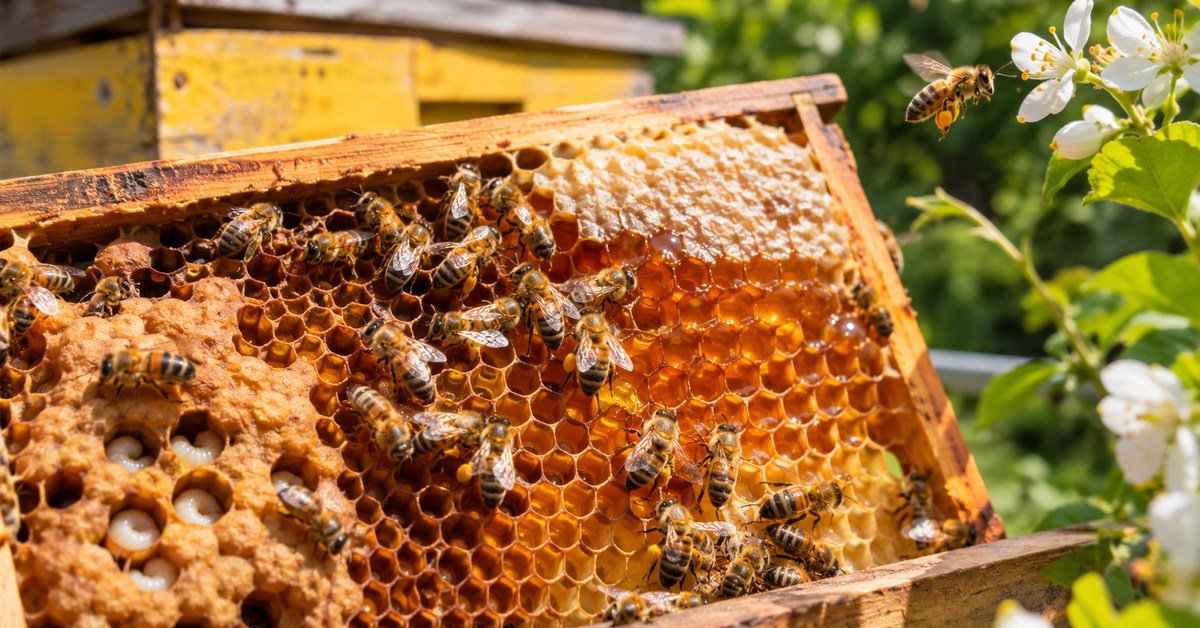
Understanding how a honey bee colony works starts with following a forager returning with nectar or pollen. That food must reach house bees and nurses before a new generation can emerge. Workers process nectar for energy, while pollen supplies nutrients for the brood-food glands of young adults. The queen’s eggs become future foragers only when each stage receives enough support.
One comb can contain fresh eggs, growing larvae, capped pupae, pollen, and honey within a small area. This placement helps nurses reach food quickly while other workers maintain the brood environment.
To read the colony, compare newly laid eggs with older brood rather than relying on a queen sighting. Next, check whether adult bees cover the brood and whether pollen and honey remain within reach. Finally, interpret those clues against weather, flowering conditions, and the colony’s recent changes.
The sections below trace how reproduction, feeding, fieldwork, and storage form a continuous cycle. A shortage today can weaken next month’s workforce even while entrance traffic stays busy. Your inspection should follow the same cycle, connecting visible symptoms with the work that supports them.
Jump to a specific section on this article
Queen, Worker, and Drone Roles in a Honey Bee Colony
Honey bee colonies contain queens, workers, and drones, each with different reproductive and practical roles. A laying queen produces fertilized or unfertilized eggs and releases important chemical signals. Female workers perform brood care, foraging, construction, food handling, defense, and nest ventilation. Male drones primarily seek opportunities to mate with virgin queens outside the colony.
A productive queen usually occupies a nest supported by thousands of daughter workers. Her laying responds to nutrition, open comb, season, and the workers attending her. Fresh eggs demonstrate recent laying but do not prove a queen remains today.
Worker bees are usually nonreproductive females under ordinary queenright colony conditions. Their numbers determine how much brood the nest can effectively feed and cover. Even abundant workers cannot compensate indefinitely for unsuitable food or serious disease.
Drones arise from unfertilized eggs and have no specialized pollen baskets for foraging. They eat colony resources while contributing to reproduction through mating flights. Colonies generally rear more drones during favorable breeding conditions. Temperate colonies often remove adult drones when seasonal food becomes scarce.
Understanding the basics of managed beekeeping is less about naming castes than about seeing how their work connects. When pollen fails to reach nurses, even plentiful eggs may produce too few replacements. Use the relationship among brood, adult workers, and stores to interpret unusual colony behavior.
The Honey Bee Brood Cycle From Egg to Emerging Adult
Honey bee brood consists of eggs, feeding larvae, and developing pupae inside comb cells. A queen typically places one small egg at the bottom of an available cell. The egg usually hatches after three days under normal nest conditions. Nurse bees feed the larva before workers seal its cell for metamorphosis.
Queens usually emerge around day sixteen, workers around day twenty-one, and drones around day twenty-four. These figures measure development after egg laying, not total lifespan. Brood temperature and other developmental conditions can shift timing slightly.
Healthy open larvae are generally pearly white and curved within their cells. Under the cappings, pupae gradually acquire recognizable adult structures and pigmentation. The emerging bee chews through its capping and joins the colony workforce. These stages are described in the Mid-Atlantic extension overview of colony development.
Several brood ages on one frame reveal laying that occurred across different days. A regular capped pattern often indicates sustained development, but gaps have several possible causes. Compare eggs, open brood, sealed brood, and adult coverage before interpreting irregularities.
Because development takes weeks, a pollen shortage can affect adult numbers after flowering conditions have improved. Compare brood ages across inspections to see whether larvae are actually becoming replacement workers.
How Nurse Bees Feed Brood and Regulate Nest Temperature
Young workers develop brood-food glands and begin nursing larvae inside their cells. They inspect developing brood frequently and supply appropriate food as larvae grow. Effective feeding requires pollen nutrients, stored energy, water, and sufficient healthy workers.
Larvae cannot transform raw pollen into their own complete diet. Nurse bees consume pollen or bee bread and use its nutrients to produce brood-food secretions. Honey and nectar provide energy for nursing, nest warmth, and other adult activity. When either food pathway weakens, newly laid eggs may not become well-fed larvae.
Brood development also demands a warm nest with relatively stable conditions. Workers generate warmth through muscular activity and cluster around brood cells. When cooling is needed, workers ventilate and distribute water for evaporation.
Opening brood frames during cold weather can quickly expose larvae to chilling. Return frames carefully and minimize time with the brood nest divided. Avoid leaving combs uncovered while deciding which frame to inspect next. A shortage of adult workers can leave expanding brood insufficiently covered.
Stored pollen near brood is useful but cannot by itself establish nutritional adequacy. Combine visible pollen stores with incoming forage and larval appearance.
Brood care succeeds when food supply, nurse numbers, and temperature remain coordinated.
How Worker Bees Change Jobs as Colony Needs Shift
Adult workers commonly begin with household tasks and transition toward outside foraging later. Newly emerged bees clean cells before taking more demanding brood-care responsibilities. Other house bees construct comb, receive nectar, ventilate, and defend entrances. Foraging becomes prominent as many summer workers reach later adult life.
These assignments respond to the colony’s changing age structure and current workload. After heavy field losses, some house bees can begin foraging earlier. When brood expands, more workers may remain inside to feed and warm larvae.
That flexibility has limits when the same workforce faces competing demands. Fewer nurses may leave larvae with inadequate food or temperature regulation. Check brood coverage and pollen availability whenever flight activity changes sharply.
A beekeeper must also accommodate seasonal time demands of beekeeping while assessing workforce changes. Growth periods require different observation priorities from cold or forage-poor weeks. Use repeated records instead of treating one inspection as a permanent diagnosis.
Task flexibility helps a colony respond rapidly when circumstances change. Competing demands still create pressure when too few workers remain available.
A bee’s age influences likely duties, but colony requirements shape actual behavior.
How Foragers Find and Recruit Bees to Floral Resources
Foragers leave their colony to gather nectar, pollen, water, and plant resins. They navigate using visual cues, learned landmarks, odors, and solar information. Successful workers can communicate rewarding collection sites to nestmates.
A waggle dance can convey approximate distance and direction to profitable flowers. Returning bees also carry recognizable odors from the resources they visited. Recruitment increases effort at productive sites without making every worker forage identically. Different individuals can visit different plant species during the same morning.
Nectar supplies carbohydrates consumed directly or eventually stored as honey. Pollen provides protein and other nutrients needed for nurse-bee development. Collected water supports brood feeding and the cooling of occupied combs.
When many larvae need protein, pollen collection can increase even during a strong nectar flow. Stored pollen and brood signals both influence how much gathering effort workers devote to pollen. Watch the baskets of several returning workers when young larvae occupy much of the comb. If brood expands without corresponding pollen, energetic entrance activity may conceal a nutritional shortage.
Pollen loads reveal one visible kind of returning resource during inspections. Observe nectar unloading and airflow around the hive during strong floral flows. Compare field activity with stored food and brood demands inside.
How Workers Transform Nectar and Pollen Into Stored Food
Nectar foragers hand liquid loads to receiving bees while pollen foragers unload compacted pellets. House workers process and reposition nectar before it becomes capped honey. Other workers pack pollen close to brood, allowing nurses to reach its nutrients.
Enzymes introduced during nectar handling help alter its carbohydrate composition. Workers spread nectar and ventilate the nest to remove excess moisture. Honey cappings generally follow sufficient ripening of the stored contents. Fresh uncapped nectar should not automatically be treated as mature honey.
Pollen loads are unloaded and packed into cells near the brood region. Workers moisten and compact pollen with other materials as needed. Stored pollen mixtures are commonly described as bee bread.
These pathways form a connected supply chain rather than two isolated piles of food. Honey fuels flight, comb construction, heat production, and other energetic work. Bee bread supports the nurses that prepare larval diets, helping eggs develop into new workers. A shortage in either pathway may restrict brood rearing despite abundant stores of the other.
Slowly lifting a frame reveals where workers are handling fresh nectar and concentrating stores. During difficult handling, controlled smoke from the VIVO BEE-V001L Large Stainless Steel Beehive Smoker may ease access to occupied combs. Use only enough cool smoke to manage the inspection without repeatedly interrupting the nest.
How Hive Bees Ripen Nectar and Seal Stored Honey
Receiving workers first place nectar in cells where its high water content begins to fall. They repeatedly handle small quantities, adding enzymes that change the sugar mixture. Fanning, airflow, and exposure of thin films encourage evaporation over time. Once honey reaches suitable storage conditions, workers commonly seal its cells with wax.
Because flowers differ in nectar chemistry, separate incoming loads can require different processing conditions.
Dry weather and adequate ventilation generally make evaporation easier than persistently humid conditions.
Inspectors can distinguish much fresh liquid nectar from capped honey by appearance. However, cappings alone cannot provide a precise measurement of extracted honey moisture. A calibrated refractometer gives a numerical moisture reading when harvesting requires one.
Why Pollen Stores Matter to Nurse Bees and Brood
Pollen foragers return with packed hind-leg baskets instead of exchanging those loads like nectar. Workers press the pellets into cells near the brood and may add nectar or secretions. Nurses consume those stores and turn their nutrients into glandular food for larvae. The pollen band therefore connects flower visits with successful emergence of new adult workers.
Plant pollens differ in their protein quality and other essential nutrients. A large pollen band cannot establish that the colony’s nutritional intake is balanced. Compare stored pollen with brood condition and the variety of flowering plants available.
Unlike honey, pollen primarily supplies materials needed for growth rather than concentrated energy. If larvae disappear while honey remains plentiful, examine incoming pollen and brood health. Inadequate nutrition can harm future worker development before food cells look empty. Consider supplemental feed only after checking forage conditions and other possible causes.
Feeding decisions should reflect actual brood demand, local flowering conditions, and season. Keep pollen combs sheltered while inspecting to protect stored nutrition and developing larvae. Return frames near their original brood positions so nurses regain access promptly.
Where Honey Bees Arrange Brood, Pollen, and Honey in Comb
Active brood commonly occupies a central region of the colony’s combs. Pollen often borders the brood, with honey farther outward or above. This arrangement provides nearby nutrition and accessible fuel for daily brood care.
Comb patterns change as a colony expands, contracts, and receives abundant forage. Worker brood often has flatter sealed cappings than raised drone brood. Drone brood frequently appears around outer brood areas in visibly domed cells. Elongated queen cells require interpretation alongside eggs, colony strength, and season.
Inspecting removable comb helps distinguish active brood space from cells allocated to food. Before assembling the BeeCastle 10-Frame Wax-Coated Langstroth Deep Brood Box, confirm its included foundations and frame depths match your hive. Uniform frame sizing and correct bee space prevent avoidable problems during later brood inspections.
As brood emerges, emptied cells can become laying space or temporary nectar storage. A heavy nectar flow may occupy cells the queen could otherwise use. However, a bare outer frame can simply lie beyond the adult cluster. Compare central brood frames with adjacent pollen and honey before changing the arrangement.
Maintain accessible food near brood when repositioning hive components. Replace brood frames in a sensible sequence to protect the existing nest layout.
How Food Sharing Supports the Entire Honey Bee Colony
Workers exchange liquid food directly through a process called trophallaxis. A nectar load delivered by one forager can eventually nourish many individuals. These exchanges also help circulate chemical information throughout the social colony.
After nectar arrives, house bees redistribute carbohydrates through repeated food exchanges. Nurses consume pollen stores and convert those nutrients into secretions for developing larvae. The queen receives nourishment from attendants while she continues egg production. Separate resources therefore pass through different workers before a new adult emerges.
Food sharing means one foraging trip can sustain bees far from the entrance. Yet shortages or poor nurse health can interrupt feeding before every storage cell is empty. Compare larval survival with accessible food rather than judging stores alone.
Checking food distribution requires steady frame handling around moving bees and exposed brood. Well-fitted Humble Bee 110-XL Goatskin Beekeeping Gloves protect hands, although bulky fingers can still crush workers. Support frames securely and shorten exposure when adult coverage over brood is thin.
The cycle closes when properly nourished larvae emerge and eventually replenish the foraging workforce. That return depends on enough food and healthy bees surviving each intermediate stage.
What Happens to Brood and Foraging During Food Shortages
Food shortages change the balance between maintaining adults and producing new bees. Queens can reduce laying when nectar or pollen becomes scarce. Nurse workers may curtail larval feeding and remove brood they cannot support. Foragers may search more widely for remaining profitable resources.
A pollen dearth deprives nurses of protein even while honey remains plentiful. Eggs laid before the shortage may produce fewer healthy adults when feeding weakens. The resulting worker deficit appears later, even after flowers begin yielding again.
Honey can remain in a winter hive yet be inaccessible to clustered bees. Cold workers sometimes cannot cross empty comb to reach distant stores. During warmer periods, consumption can simply exceed the supply entering the nest. Evaluate nutrition alongside queen health, parasites, and robbing before changing management.
During first-season colony changes, compare young larvae with the pollen entering the hive. Check whether nurses cover the comb and usable stores remain within easy reach. When shortages are confirmed, follow locally appropriate feeding guidance rather than treating every quiet hive alike.
Reduce exposed syrup, opened honey, and other attractants during forage gaps. Robbing can worsen depleted reserves and disrupt guards already protecting a weakened hive. After forage returns, check whether new eggs progress into healthy larvae.
Seasonal Changes in Honey Bee Brood and Food Reserves
Season and climate reshape brood production, foraging intensity, and food allocation. Many temperate colonies increase rearing during warm spring pollen flows. Summer nectar availability may fill combs while workers sustain active brood. Colder or forage-poor periods usually reduce opportunities for rapid growth.
Winter colonies in cold areas cluster and depend on reachable stored honey. Longer-lived winter workers help bridge the gap until renewed brood emergence. Warm-region colonies may instead follow flowering changes associated with rainfall.
Two nearby apiaries can reach different seasonal peaks when floral resources differ. Rainfall, elevation, and local planting influence when pollen and nectar become available. An inspection diary connects those observations with the annual workflow inside a managed hive rather than arbitrary calendar dates.
Before acquiring bees, a realistic first-year hive plan should account for swings in adult population. Record your region’s recurring pollen and nectar flows over several seasons. Compare frame coverage and food stores with past inspections before making changes. Leave sufficient stores rather than treating visible surplus as automatically harvestable.
A nest with ample honey can still lack protein for growing larvae. Colonies ending a nectar flow with depleted stores may need quick assessment. Queen performance and parasite pressure determine how resources become new adults.
Interpret seasonal progress through brood, adult coverage, incoming forage, and reachable food together.
Frequently Asked Questions about How a Honey Bee Colony Works
Can a honey bee colony keep working after losing its queen?
Yes, workers normally continue gathering food, tending existing brood, and defending the nest after queen loss. However, no new fertilized eggs arrive until a replacement queen begins laying. If suitable young female larvae remain, workers may start raising emergency queens. The colony then needs a replacement to emerge, mate, and restore production of worker brood.
A queenless colony may maintain substantial entrance traffic for several weeks. Existing capped brood can still emerge while the youngest brood disappears. Repeated observations of new eggs provide stronger evidence than flight activity alone.
Queen cells do not always mean the original queen is dead. Swarming and supersedure can produce cells under different circumstances. Review colony history and brood ages before attempting corrective action.
Do honey bees stop working inside the hive at night?
No, house bees perform essential duties during nighttime hours. Nurses feed brood while other workers distribute food and regulate temperature. Foraging mostly pauses when daylight and weather no longer permit flight. Nighttime workloads vary with brood demand and current nest conditions. An observer should avoid opening a colony merely to confirm nocturnal activity.
Can one forager carry nectar and pollen on the same trip?
Yes, an individual honey bee can collect nectar and pollen during one outing. Nectar travels internally in the honey stomach while pollen occupies hind-leg baskets. Some workers focus mainly on one resource during particular flights. The balance changes with flower structures and current colony demand.
Pollen baskets establish that a worker gathered pollen but not her nectar amount. Bees lacking visible pollen loads may still have collected valuable nectar. Observe many returning workers before judging an entire day’s forage.
Do honey bees from one colony all visit the same flowers?
No, workers from one hive can use different plants and forage locations. Dance recruitment encourages visits to rewarding patches without eliminating individual choice. Flower availability changes during the day and between weather events. Some workers leave to seek water or plant resins instead.
Different pollen colors can suggest several plant sources entering the nest. However, similar colors can represent unrelated plant species. Color alone cannot establish the diversity or nutritional quality of forage.
A major flowering event may temporarily concentrate many workers nearby. Foragers redirect efforts as profitable patches change or fade. Record local bloom periods to interpret changing entrance traffic.
Why might honey bees remove larvae or pupae from the hive?
Workers may remove unhealthy or mite-affected brood as part of hygienic behavior. Food shortages can also lead to removal of larvae the colony cannot support. Chilled brood may appear outside after abrupt temperature changes or poor adult coverage. Look for a pattern across frames before interpreting any single discarded pupa. Persistent abnormal cappings or discolored larvae justify qualified local extension advice.
Inspect unusual brood patterns for discoloration, holes, and inconsistent age distribution. Certain serious diseases require laboratory confirmation and specific local reporting. Seek qualified extension assistance when the signs suggest a regulated brood disease.
Does a large brood nest always indicate a strong colony?
No, extensive brood must be supported by enough healthy adults and accessible food. Rapid expansion can strain a colony during cold weather or forage failure. Brood survival matters as much as the total capped area. A smaller covered nest may fit the season and colony size.
Compare eggs, larvae, capped cells, and adult coverage together. Look for brood patches left exposed by inadequate worker numbers. Compare similar local hives before interpreting the overall nest size.
The queen’s laying potential does not guarantee equivalent numbers of new workers. Nutrition and parasite pressures influence the survival of immature stages. Successful emergence must also be followed by adequate adult care.
Assess whether resources and worker numbers match the current brood demand.
Why can a bee colony starve while honey remains in its hive?
Honey on a distant frame cannot help a winter cluster unable to cross a cold, empty gap. Reachable stores beside the bees matter more than honey visible elsewhere in the box. Illness and reduced adult numbers can also impair movement and food use. During suitable weather, assess both store placement and cluster coverage before intervening.
Can honey bees eat crystallized honey in the comb?
Yes, bees can consume crystallized honey under conditions allowing them to dissolve it. Access to moisture may influence how readily they use granulated stores. Some nectar sources produce honey that crystallizes sooner than others. Crystallization itself does not establish that the stored food is harmful.
Check overall reserves rather than assuming every firm cell is unusable. A cold cluster may struggle to reach even nearby liquid honey. Avoid prolonged comb exposure during freezing or windy weather.
Do honey bees move stored food between comb cells?
Yes, workers can shift nectar and honey while reorganizing their occupied combs. Fresh nectar may occupy temporary cells before more suitable final storage. Comb usage also changes as brood emerges and laying space opens. Moving liquid stores can support ripening and redistribution of available space.
Pollen tends to remain concentrated near actively growing brood. Workers consume existing pollen and later refill storage cells. One inspection therefore captures a changing arrangement rather than fixed compartments.
Rearrangement does not necessarily indicate disease or poor hive management. Nectar flows and changes in brood area alter cell usage. Compare several inspections before interpreting storage movement as a problem.
Will honey bee colonies share food with neighboring hives?
Neighboring hives do not normally maintain a cooperative food-sharing network. Workers may enter foreign colonies through drifting or through active robbing. Robbing removes stores from a weaker hive rather than supporting it. Drifting workers sometimes join another colony without coordinating resource exchanges.
Food shortages increase the risk of robbing around weak entrances. Open honey and spilled syrup can attract workers from nearby hives. Limit spills and keep each colony capable of guarding its entrance.
Crowded apiaries may also experience parasite movement associated with drifting bees. Watch weak entrances for fighting and unusually frantic traffic. Monitor every colony’s stores independently instead of expecting neighboring support.
Unusual cross-hive traffic should prompt inspection rather than assumptions about cooperation.
A Few Last Things to Know About How a Honey Bee Colony Works
To understand how a honey bee colony works, trace eggs through nursing, foraging, and food storage. Pollen nourishes nurses that rear future workers, while ripened nectar fuels their work. During suitable inspections, compare brood ages, adult coverage, incoming pollen, and reachable honey. If one link in that chain weakens, identify its cause before rearranging comb or feeding.