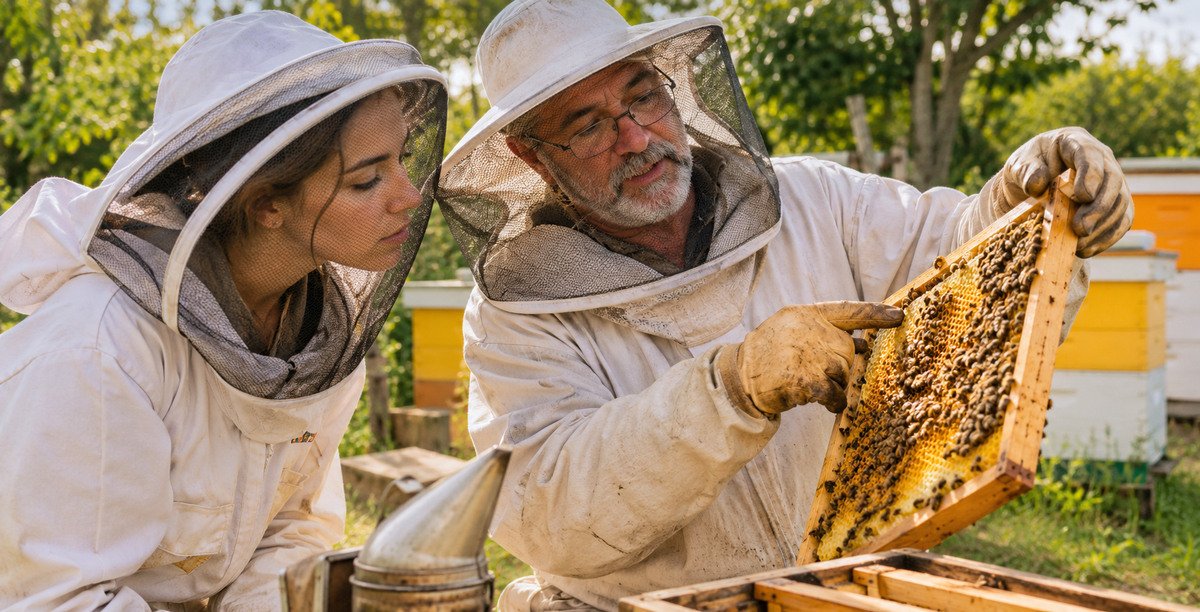
To learn how to choose a beekeeping mentor, watch them teach a real hive inspection. Strong candidates demonstrate safe techniques, let beginners practice, and explain decisions using colony evidence. A beekeeper who manages many colonies may still be an ineffective instructor. Look for clear feedback, local knowledge, practical access, and an agreed route toward independence.
An effective mentor lets you handle appropriate tasks while keeping the bees and people safe. Their feedback should explain what you saw, what it means, and what you should check next.
Begin by deciding which skills you must demonstrate during your first beekeeping season. Ask each candidate how they supervise inspections, monitor colony health, and assess a learner’s technique. Compare their answers against your climate, hive system, and access to suitable practice colonies.
A trial visit reveals more than a mentor’s credentials or general reputation. Observe their safety checks, opportunities for learner participation, explanations, corrections, and plans for the next visit. Compare those five indicators before choosing someone to guide your first season.
Jump to a specific section on this article
Identify the Hive Skills Your Beekeeping Mentor Must Teach
Define the skills you need before interviewing a prospective mentor. Your initial targets should include safe opening, frame handling, brood identification, food-store checks, and accurate field notes. Ask how the teacher decides when weather or colony behavior makes opening unwise. Each lesson should connect an observable skill to a decision you will eventually make yourself.
Beginner inspections need a purpose before the cover comes off. Your mentor should name the question, describe what evidence would answer it, and limit disturbance. This makes later visits easier to compare rather than merely more frequent.
Learning to distinguish eggs, larvae, capped brood, and stored food is more valuable than collecting unfamiliar terminology. Observe how the mentor changes inspection depth when colonies become defensive or weather deteriorates. Request an explanation whenever a recommended action has a seasonal deadline.
Skill selection should follow your colony’s actual stage, not a fixed demonstration script. When planning a first season from preparation through inspections, connect each lesson to the next field decision. Practice preparing a smoker safely while keeping sparks and hot metal away from clothing. The VIVO BEE-V001L large stainless steel beehive smoker provides a heat shield and removable fire base for discussing safe handling.
Finish each lesson by explaining one observation, its significance, and the next safe action. Record the date, colony conditions, your decision, and any prompts needed from the mentor. Revisit the record next time to see whether the skill transferred beyond that demonstration.
Find Beekeeping Mentors Who Know Your Local Conditions
Nearby beekeepers understand the forage gaps, swarm periods, and weather interruptions that a distant adviser may miss. Ask candidates which months usually bring colony expansion and which demand closer food monitoring locally. Their answers should describe conditions rather than claim an identical calendar every year. A mentor who admits uncertainty about a new season offers more usable guidance than someone promising fixed dates.
Local experience also includes knowledge of legally required registrations, disease reporting, and hive placement rules. Requirements differ by jurisdiction, so ask where the current official guidance can be checked. Membership in a regional beekeeping association can help you find mentors and verify local practices.
Notice whether prospective mentors adjust their advice when weather or forage is unusual. Sound teaching distinguishes an observed shortage from a prediction about the next nectar flow. The mentor should show how to inspect stored food before recommending a response. Compare their seasonal reasoning with what happens during an early beekeeping season and ask which local factors differ.
If you keep bees in town, ask about flight paths, water, neighboring properties, and access. Rural locations may raise different problems involving livestock, long travel times, or pesticide exposure. The strongest candidate can describe how those conditions alter practical inspections and emergency plans.
Choose someone who maintains colonies in conditions reasonably similar to yours. A distant specialist can supplement lessons, but cannot always replace nearby field support.
Check a Beekeeping Mentor’s Teaching Record and References
Beekeeping experience matters, but teaching ability needs separate evidence. Ask each candidate how many beginners they have supervised through seasonal changes. Request a specific example showing how they corrected a learner’s mistaken inspection conclusion.
Speak with two former learners when references are available, preferably at different experience levels. Ask what tasks they actually performed and when they stopped needing prompts. Find out how quickly the mentor responded to confusing observations or canceled field sessions. A useful reference recounts a corrected mistake, not merely a pleasant personality.
Structured training programs offer concrete examples of field competency records. Oregon State University’s apprentice pathway requires four signed field worksheets and four hive maintenance log entries. Ask whether the candidate uses an equally clear way to document demonstrations and progress.
Ask a former student which activities they were allowed to perform rather than only observe. Determine whether the mentor checked hive notes or explained why a diagnosis needed revision. If you are evaluating the early challenges of beekeeping, seek references who struggled with similar practical tasks. Their account may reveal whether teaching adapted to a learner’s pace.
Treat credentials as one part of the evidence, alongside demonstrable field instruction. Prefer a candidate who welcomes questions and can identify the limits of personal experience.
A strong reference identifies the field task the learner could eventually perform without prompting.
Match Your Mentor’s Hive System to Your Practice Setup
Hive formats differ in how frames are lifted, brood is inspected, and equipment is exchanged. Ask which box dimensions and frame systems your prospective mentor actually manages. A beekeeper experienced only with movable-frame equipment may not demonstrate every procedure for top-bar hives. Match the mentor’s hands-on expertise to the system you intend to keep.
Compare the mentor’s smoker, hive tool, protective clothing, and record system with your own setup. Exact brand matching is less important than understanding how each tool works with your hive. Procedures that rely on incompatible boxes or frame dimensions can make supervised practice confusing.
Before choosing equipment, ask how your mentor demonstrates safe frame removal and replacement. A demonstration must leave enough working space to avoid crushing bees. Clear instructions should explain what changes when a box is heavy or heavily propolized.
The practical limitations of one hive matter when a mentor expects you to compare colonies. With one colony, you may need supervised access to additional examples elsewhere. Discuss whether the mentor can arrange suitable comparisons without moving bees or equipment unnecessarily.
Your practice plan should fit your actual hive access and physical abilities. Ask to rehearse basic movements before managing a densely populated colony.
A good match helps you transfer a demonstrated action directly to your own apiary.
Use a Trial Hive Visit to Assess a Beekeeping Mentor
Before a trial visit, choose five criteria: safety, participation, evidence-based explanations, corrective feedback, and follow-up. Agree on a suitable learner task and who will intervene if conditions change. Ask the mentor to state the inspection’s purpose and the safety conditions for stopping.
During the visit, note whether safety checks happen before the hive is opened. For each criterion, record demonstrated, partial, or absent alongside one observable example. Watch whether the teacher invites your interpretation before describing their own. Treat unsafe handling as a reason to reject the candidate, regardless of other strengths.
After observing a frame, identify one brood feature, one food-store clue, and one uncertainty. Ask the mentor to correct your reasoning before proposing an action. Record whether you performed the task independently, needed prompts, or only watched.
Tools should support the lesson rather than become its main attraction. During controlled bee removal, the Little Giant BKBR14 14-inch beekeeping brush provides a practical handling example. Observe whether the mentor explains when brushing is necessary and demonstrates gentle, limited movement. Ask how the tool is cleaned before being used around another colony.
Compare two or three candidates against the same five criteria when suitable trial visits are possible. Prioritize safe practice, evidence-based instruction, and constructive correction over confidence or colony counts. Choose the teacher who names a clear skill you can demonstrate at your next meeting.
| Selection criterion | Question to ask | Positive evidence | Warning sign |
|---|---|---|---|
| Teaching approach | What will I handle during a supervised inspection? | Demonstrates a task, observes your attempt, then offers specific feedback. | Only permits passive observation without explaining a learning progression. |
| Safety judgment | When would you stop or postpone an inspection? | Checks weather, colony behavior, protective equipment, and emergency arrangements. | Continues despite unsafe conditions or inadequate protection. |
| Local knowledge | How do local conditions affect your colony-management advice? | Explains seasonal forage, weather, local requirements, and relevant uncertainty. | Applies the same management calendar regardless of location or conditions. |
| Evidence-based decisions | What observations would make you change your recommendation? | Separates colony observations, measurements, assumptions, and possible alternatives. | Recommends interventions without explaining supporting evidence. |
| Corrective feedback | How would you correct my frame-handling mistakes? | Identifies the error, demonstrates a safer movement, and supervises another attempt. | Blames the learner or takes over without explanation. |
| Field access | When can I practice on suitable colonies? | Offers realistic supervised opportunities and accommodates unsuitable inspection conditions. | Cannot explain when or how hands-on practice will occur. |
| Independence | How will we know I can inspect a hive without prompts? | Uses observable field skills, reviewed records, and progressive learner responsibility. | Provides no clear learning milestones or assessment method. |
Ask How a Beekeeping Mentor Makes Hive Skills Repeatable
Repeatable hive skills need an observable standard, not another demonstration alone. Ask your mentor to name the action, the evidence to notice, and a safe stopping condition. Then repeat the task on a later suitable visit and compare what you recorded.
Begin with an inspection purpose, protective preparation, and a brief external assessment. Have the learner describe a brood feature, food-store evidence, and one unresolved question. Record any appropriate mite sampling result with the date, method, and sample size. Close carefully and explain what observation would justify the next inspection.
Reliable mentor guidance separates visible symptoms from a confirmed diagnosis. For mite control, the Honey Bee Health Coalition’s varroa management guidance explains sampling and treatment decision factors. Ask your mentor to show the measurement before recommending a control action.
Use three teaching passes: mentor demonstrates, learner performs with prompts, then learner explains and leads. After each pass, identify one successful behavior and one skill requiring correction. Repeat on another suitable visit to test whether the learner can adapt to changed conditions. Mark the task independent only when the learner performs safely and explains the evidence.
Choose a mentor who describes the evidence required before signing off a field skill. Record the date, task, observed performance, and any prompts needed. This shows progress more clearly than simply counting hive visits.
Practicing Hive Inspection Steps in a Consistent Order
Agree on a consistent inspection sequence before opening the colony. Check external activity, prepare equipment, and state the question the visit should answer. Follow a deliberate frame order while preserving orientation and avoiding unnecessary brood exposure. Restore spacing, close the hive carefully, and document what you observed.
On a supervised frame, describe visible brood or stores and state what remains uncertain.
Before leaving, record the next action, supporting evidence, and the conditions that could change it.
Repeat the sequence later without the mentor naming every step. Ask for immediate correction when a step risks unnecessary disturbance or bee injury. Treat the skill as learned when you can perform and explain it safely.
Explaining Beekeeping Decisions From Colony Evidence
Ask why a proposed intervention is necessary now instead of after another observation. Require three elements: observed evidence, consequences of waiting, and plausible alternatives. Compare brood, food stores, population, and recent weather before interpreting an isolated sign. Name the finding that would justify revising the decision.
A few bees carrying pollen do not by themselves prove adequate colony food stores. Likewise, an appealing brood pattern does not replace a mite monitoring result. Your mentor should explain what each observation can and cannot establish.
During mite instruction, distinguish visual screening from quantitative sampling. Record the method, sample size, mite count, and the basis for any decision threshold. Check local guidance and approved product labeling before choosing a control. Repeat measurements with comparable methods when assessing whether conditions have changed.
Finish each exercise with a written action, supporting observations, and follow-up date. Compare the next inspection with the original expectation, noting where the evidence differed. Explain a changed decision without treating justified revision as failure.
| Field skill | Learner demonstrates | Mentor checks | Pause or seek support when |
|---|---|---|---|
| Inspection preparation | Checks protective clothing, equipment, weather, and the inspection objective. | Preparation is complete and the learner can explain when to postpone opening. | Protective equipment fails or conditions become unsafe. |
| Frame handling | Removes, supports, examines, and replaces frames with controlled movements. | Frames remain stable, spacing is restored, and unnecessary bee injury is avoided. | The frame becomes unstable or the learner loses control. |
| Brood and stores assessment | Identifies visible brood stages and food stores while stating uncertain findings. | Observations are distinguished from diagnoses and management assumptions. | Abnormal brood suggests disease or findings require expert interpretation. |
| Varroa monitoring | Explains the locally appropriate sampling method and records the method and result. | Sampling is performed correctly and results are interpreted using applicable guidance. | Sampling validity, local thresholds, or proposed controls are uncertain. |
| Management reasoning | States the observed evidence, proposed response, alternatives, and follow-up conditions. | The decision follows evidence rather than an unsupported assumption. | A proposed intervention lacks evidence or required authorization. |
| Hive hygiene | Handles shared tools carefully and avoids unnecessary transfer of potentially contaminated materials. | Equipment handling follows appropriate local biosecurity practices. | Suspected infectious disease requires specialist or official guidance. |
| Inspection closeout | Restores the hive, accounts for equipment, and records observations and next steps. | The hive is securely closed and the field record supports the next decision. | Colony condition or incomplete closure requires immediate attention. |
Ask How a Beekeeping Mentor Corrects Your Field Technique
Useful correction names the action, its visible effect, and the safer replacement. Ask whether the mentor offers one specific adjustment before taking over, except when safety requires immediate intervention. This makes feedback understandable and allows improvement to be checked later.
If you roll bees while replacing a frame, the correction should focus on spacing and controlled movement. When a frame is tilted too far, ask how to maintain a stable grip. If smoke is excessive, practice a lighter application while observing colony behavior. Avoid mentors who treat abrupt handling as proof that learners must simply become tougher.
Use a teach-back check after a mentor demonstrates an inspection step. Repeat the technique on separate suitable occasions while explaining what you are checking. Ask the mentor to record whether prompts were necessary and why.
Stop immediately when protective clothing fails or colony behavior makes continued handling unsafe. Other errors call for a concise explanation followed by another supervised attempt. Agree on a signal that transfers control back to the mentor. Note the correction and whether your next attempt improved that particular movement.
A practical mentor ends each visit with one task and a clear success criterion. That might mean replacing a frame smoothly while maintaining spacing and avoiding unnecessary bee injury.
Check Mentor Plans for Bee Stings and Hive Hygiene
Safety teaching begins before anyone approaches the hives. Ask the mentor how they manage sting risk, protective clothing, and unexpected reactions. Confirm who will act if a participant becomes unwell and how emergency help will be reached.
Protective gear should fit securely without restricting vision or controlled movement. During a suit-fitting lesson, the Humble Bee 410 polycotton beekeeping suit with round veil in olive XX-Small illustrates variant-specific sizing. Its elastic cuffs and thumb holds provide features to check, without promising protection from every sting. Confirm that the learner’s actual suit, veil, gloves, and footwear close correctly before practice.
Check whether the mentor screens participants for known serious sting reactions before a visit. Anyone prescribed emergency medication should keep it accessible and follow their clinician’s instructions. The mentor should know when to stop work and seek emergency assistance.
Good hygiene also involves checking equipment for visible contamination before moving between colonies. Ask how tools, gloves, and borrowed equipment are cleaned when disease is suspected. Unexplained brood abnormalities should trigger cautious handling and consultation with appropriate local bee-health authorities.
Never accept routine transfer of potentially contaminated comb as a teaching shortcut. A strong mentor treats biosecurity and human safety as essential field skills.
Check Beekeeping Practice Frequency and Hive Access
Useful practice access matters more than the number of messages a mentor sends. Ask how many supervised sessions can reasonably occur during your local active season. Oregon State’s apprentice program uses four signed field worksheets, providing one documented training model. Your schedule should prioritize seasonal tasks and allow postponement when hive opening is unsafe.
Use early sessions for safe handling, brood recognition, and food-store observations. Reserve later opportunities for health monitoring, seasonal reasoning, and a supervised learner-led inspection. Ask how cancellations will affect that progression rather than insisting on fixed dates.
Discuss whether you may attend visits to more than one colony when circumstances allow. Comparing two healthy colonies can reveal how population and food stores change management choices. However, moving equipment between apiaries introduces biosecurity questions that your mentor should address. Do not schedule observations simply to meet an arbitrary visit quota.
Estimate the work involved by reviewing how beekeeping time changes during the year alongside your availability. Agree on notice periods for changing plans and asking questions between visits. Make clear whether short urgent messages are possible or whether another local contact is needed.
Choose sessions that include hands-on practice, written feedback, and a specific follow-up task. After each visit, send a concise log and identify one remaining question. A shorter, purposeful apprenticeship can teach more than a calendar filled with passive demonstrations.
Choose a Beekeeping Mentor Who Plans for Your Independence
A good mentor defines an exit standard rather than promising indefinite guidance. Ask which four tasks you must demonstrate before managing routine inspections independently. Useful checkpoints include preparing safely, interpreting a frame, recording evidence, and planning a next observation. Agree that suspicious disease signs or serious safety concerns still require qualified local support.
First, describe the steps while the mentor demonstrates, then perform them with prompts. Later, plan and lead one suitable inspection while the mentor observes without directing every action. Compare your written interpretation with the feedback before recording a skill as independent.
Independent judgment includes knowing when a problem exceeds your training. You should be able to recognize unusual brood signs, severe defensiveness, or uncertain disease symptoms. Ask where expert advice and official reporting support can be obtained locally.
For a final supervised check, explain the inspection purpose and safety plan before opening. Present an observation log, provisional assessment, and specific follow-up date. Ask your mentor to document any prompts needed and one skill requiring further supervised practice.
Keep contacts among local beekeepers, educators, and bee-health professionals after formal mentorship ends. Arrange a later lesson if an important seasonal task has not yet been practiced. Use observation-first reasoning when seeking advice from someone new. Independence means managing routine work while knowing when your experience is insufficient.
Choose the mentor who can demonstrate your growing competence, not merely count your hive visits.
Frequently Asked Questions about How to Choose a Beekeeping Mentor
Should I Pay a Beekeeping Mentor or Look for a Volunteer?
Start by looking for an experienced volunteer through a local association or established training program. Many good mentors donate time because they want new beekeepers to develop reliable skills. A paid arrangement can also work when it specifies supervised practice and expected availability. Judge the structure and teaching quality rather than assuming either payment model is better.
Ask how many field visits are included and whether notes receive feedback between sessions. Clarify travel, access to colonies, and what happens when weather cancels a lesson. Agree on clear boundaries before accepting a mentorship arrangement.
A volunteer may have limited availability during busy harvesting or swarm periods. A paid teacher may offer scheduled sessions without providing emergency support. Choose the arrangement that supplies the learning opportunities you actually need.
Can I Choose a Beekeeping Mentor Before I Own Any Bees?
Yes, finding a mentor before purchasing bees gives you time to assess their teaching approach. You can observe an inspection, practice protective preparation, and discuss suitable hive systems. Ask how they recommend planning for your local climate and available forage. Their advice can help you avoid equipment that does not match your intended setup. Early contact also provides a chance to arrange support for your first colony installation.
Can Two Beginners Share the Same Beekeeping Mentor?
Yes, two beginners can share a mentor when each gets meaningful supervised practice. Agree that both learners will handle appropriate tasks instead of letting one person dominate. Rotate observation, frame handling, note taking, and decision explanations between visits. Keep separate learning records so individual progress remains visible.
Ask whether the colony can tolerate the planned group size and time spent open. Larger groups may need shorter demonstrations or additional instructors. Choose a schedule that allows each learner to demonstrate skills safely.
Is Remote Beekeeping Mentorship Enough to Develop Field Skills?
Remote guidance is useful for reviewing records and discussing photographs, but beginners also need supervised hive handling. Video calls can clarify a brood observation or help prepare questions before a visit. They cannot reliably replace watching how someone handles frames beside a living colony. Arrange local field sessions whenever physical techniques or safety decisions need evaluation.
Record a short description of colony conditions before contacting a remote adviser. Include recent observations, weather, and any measured results rather than sending only one close-up image. Ask the adviser to distinguish what the evidence shows from what remains uncertain.
Use remote mentorship as a supplement once your handling skills are developing. A local beekeeper can intervene promptly if a colony becomes unexpectedly defensive. Keep emergency contacts separate from routine remote lesson arrangements.
What if a Beekeeping Mentor Also Wants to Sell Me Bees?
Ask the mentor to separate teaching recommendations from any bees or equipment they offer for sale. Request the reasons for a suggested colony type, timing, and source. Compare those recommendations with information from an independent local association or extension adviser. Confirm which health documentation and inspection requirements apply where you keep bees. Declining a purchase should not end a genuinely supportive teaching relationship.
A mentor may legitimately supply bees and provide installation help afterward. The potential conflict arises when commercial interests replace evidence about what your apiary needs. Choose someone willing to discuss alternatives without pressure.
How Should I Handle Mentor Advice That Conflicts With My Beekeeping Course?
Ask both sources what observations or local conditions support their recommendations. Different advice may reflect climate, hive type, season, or changes in disease guidance. Compare the proposed action with current extension recommendations and legally approved treatment instructions. Do not combine incompatible methods merely to satisfy both instructors.
Request that your mentor explain what evidence would change their decision. Bring the course material to the next discussion rather than relying on memory. Identify which details are documented and which are practical preferences.
For issues involving disease reporting or pesticides, follow current local rules and product labels. A qualified regional bee-health professional can help resolve consequential disagreements. Record the final decision and the reason for choosing it.
Reasoned disagreement can be a valuable lesson when both teachers welcome evidence.
What if My Beekeeping Mentor Is Unavailable During an Urgent Hive Problem?
Set up a backup contact before you need urgent advice. Ask your local association or extension service where reliable emergency guidance is available. If you suspect a reportable bee disease, contact the relevant local authority promptly. Avoid opening or moving a stressed colony repeatedly while trying to diagnose it alone.
Should a Beekeeping Mentor Guarantee That My Colony Will Survive?
No mentor can responsibly promise a colony will survive every season or health challenge. Weather, forage, parasites, disease, and colony condition all affect outcomes. A credible mentor explains how to monitor risks and respond to emerging evidence. Ask how they review losses without guessing at a single cause.
Strong teaching focuses on decisions you can document and improve over time. Compare pre-season plans with later observations to see where assumptions failed. Treat promises of effortless success as a warning sign.
When Should I Switch to a Different Beekeeping Mentor?
Consider switching when repeated lessons lack safe practice, specific feedback, or credible reasoning. One canceled visit or a respectful disagreement is not enough by itself. First explain the skills you still need and request a clearer teaching plan. If the pattern continues, seek another mentor whose approach fits your learning goals.
Serious safety lapses justify ending a session immediately rather than waiting for gradual improvement. Insulting feedback, pressured purchases, or dismissal of disease concerns also require attention. Ask a local association for another qualified contact.
Preserve your own inspection notes so a new mentor can understand the colony history. Briefly explain what you have learned and which tasks still need supervision. A constructive transition protects both your progress and your bees.
Should I Have a Written Agreement With My Beekeeping Mentor?
A short written agreement is useful whenever expectations, access, or responsibilities could become unclear. Record the learning goals, planned visits, communication methods, and who provides protective equipment. Specify how weather cancellations and urgent questions will be handled. Keep the language practical enough to review before the first session.
If you visit another person’s apiary, discuss safety briefings and permission to handle equipment. Clarify whether photographs or notes may be shared outside the arrangement. Check any relevant local rules about access and responsibility.
Review the agreement after several visits to see whether the teaching plan still fits. Update learning goals as you become able to inspect and interpret colonies independently. A simple record of expectations can prevent avoidable misunderstandings.
Choose clear commitments that support supervised practice rather than complicated promises about results.
A Few Last Things to Know About How to Choose a Beekeeping Mentor
To choose a beekeeping mentor, compare safety, hands-on instruction, diagnostic reasoning, corrective feedback, and reliable follow-up. Use a supervised trial visit to record direct evidence for each criterion. Agree on a skill progression from demonstration through prompted practice to independently explained decisions. Select the person who makes you safer, more observant, and better prepared for your next hive inspection.