
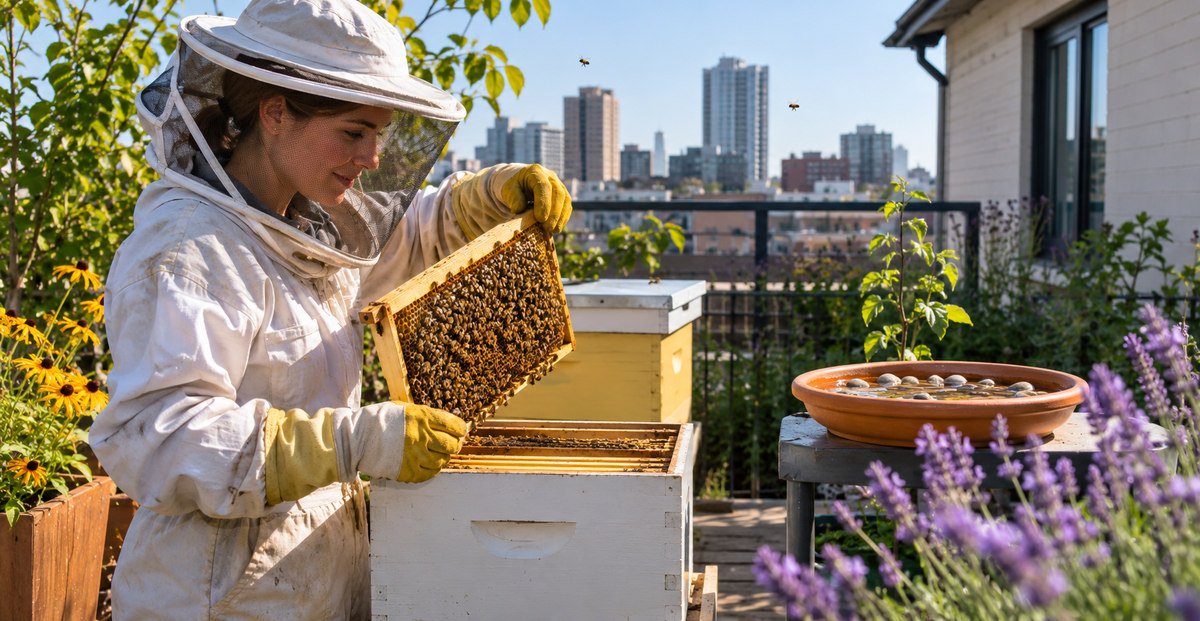
Urban beekeeping basics start with a practical question: can bees leave your yard without crossing someone else’s daily route? Even a compact courtyard can work when permissions, entrance direction, water access, and inspection space fit together. The decisive measurement is often the usable corridor around the hive, not the box’s footprint. Before bringing bees home, map gates, shared paths, outdoor seating, and the space needed to lift boxes.
Consider an ordinary inspection, a hot afternoon, and an unexpected swarm call before accepting the location. Each task should be possible without occupying someone else’s patio or blocking the only shared exit.
Water placement is equally important because foragers may discover swimming pools, birdbaths, or pet bowls first. Providing a dependable source before bees arrive gives them an appropriate place to begin collecting. A dependable refill arrangement matters more than an attractive bowl that dries up during a heatwave.
Give immediate neighbors a contact route and explain what you will do about swarms, water visits, or defensive bees. Before ordering bees, fit your first-year beekeeping plan around the site’s permissions, access limits, and seasonal demands. Make the hard placement decisions before installation, when changing the plan does not require moving a live colony.
Jump to a specific section on this article
Check Urban Beehive Setbacks Before Choosing a Site
A legal setback is a measured requirement, so confirm the rule for your address before drawing the final site plan. Municipal rules can govern property-line setbacks, colony counts, registration, and barriers, while leases impose separate conditions. A single-family yard, rented rooftop, and shared residential courtyard may fall under different approvals or restrictions. Check the current municipal code and ask the responsible authority about ambiguities before ordering a colony.
Imagine a 20-by-30-foot courtyard: draw the gate, neighboring patio, windows, and likely hive entrance before measuring. Measure from the precise reference point named in your ordinance, then mark pedestrian routes and working clearances separately. Preserve access for delivery workers, maintenance crews, emergency services, and anyone passing without protective clothing.
A six-foot flight screen may improve traffic flow while still failing a separate property-line setback requirement. Distinguish the legal boundary measurement from the practical path bees take through the first few yards. Where an exception is possible, request the authority’s decision in writing before paying for installation or bees.
Read lease conditions and building rules separately from city ordinances because either may restrict managed colonies. Property owners should also consider liability coverage and procedures for reporting injuries or nuisance complaints. Keep copies of permissions, registration records, and the site plan where a future resident can find them. If the site cannot meet every applicable restriction, select another location before introducing bees.
Retest the sketch if a new gate, play area, hedge gap, or upstairs seating space changes pedestrian patterns. Even a compliant setback can leave returning bees passing directly through a frequently occupied outdoor dining area. Treat legal compliance as the starting condition, then improve the practical separation between people and bee traffic.
| Site decision | What to confirm | If the site fails the check |
|---|---|---|
| Permissions and property lines | Current local ordinances, any registration, required separation, and written owner or building approval. | Change the proposed location or secure the necessary approval before obtaining bees. |
| Entrance flight corridor | Departing bees can gain height away from doors, balconies, and commonly used sidewalks. | Reorient the entrance, assess a secure flyway screen, or choose another site. |
| Inspection workspace | Boxes can be lifted and temporarily staged without obstructing a shared path or requiring unsafe twisting. | Move the stand or reduce the number of colonies until the full workflow fits. |
| Water access | A dependable, maintainable source has safe landing surfaces and does not create stagnant water or overflow. | Establish the station and refill plan before bees arrive. |
| Neighbor and emergency access | Gates and exits stay open, other occupants know whom to contact, and urgent hive removal is possible. | Revise access, operating arrangements, or the location rather than relying on informal workarounds. |
| Rooftop-specific safety | A qualified professional confirms structural suitability; safe carrying access, wind exposure, and drainage are addressed. | Do not install roof hives until those conditions are resolved and documented. |
Match Urban Hive Numbers to Available Space and Forage
Decide colony count only after demonstrating you can open, lift, and safely remove every hive from the site. Two boxes may fit beside a narrow path, yet the open lids and removed supers can block it completely. Each colony needs a workable approach, a clear entrance, and a practical route for carrying equipment. A permitted maximum of several hives does not mean the property can support them without creating nuisance traffic.
Oregon State’s residential guidance suggests beginners manage one or two colonies while learning to control defensive behavior. Where only one hive fits, compare the trade-offs of beginning with one colony against your access to nearby mentors. Two colonies offer comparisons and possible management support, but each requires individual feeding, health checks, and swarm planning.
Urban flowering trees, street plantings, and gardens may provide nectar and pollen at different times. A flowering street tree supplies a temporary resource, not evidence of reliable forage throughout summer and autumn. Other managed colonies and wild pollinators may also depend on the same seasonal resources. Record which plants flower each month, then compare those observations with actual stores inside the colony.
A strong nectar flow can be followed by scarcity when irrigation stops or successive plants finish flowering. Track colony weight trends, food stores, brood pattern, and foraging activity through the local season. Work with experienced nearby beekeepers when interpreting a sudden change that may have several causes.
Expand only when the additional colony has space, suitable forage, and a management plan for swarming or relocation. If access already feels cramped with one open hive, increasing the hive count will compound the problem.
Compare Ground-Level and Rooftop Urban Hive Sites
A ground-level corner usually allows easier equipment removal, emergency access, and repeatable inspections than a roof. Its main weakness is that departing bees may share head-height space with walkers before they gain altitude. Screened entrances and careful positioning can reduce direct encounters without excluding every visiting bee.
A roof can elevate the flight corridor, yet the building must support loaded hives, equipment, and working people. A qualified building professional must establish whether the roof can safely carry people, equipment, and fully loaded hives. Confirm that ladders, stairs, doors, and roof hatches can accommodate safe equipment movement. Do not assume an unused flat roof has adequate load capacity simply because it looks sturdy.
A hot rooftop also needs a reliable water refill route, secure wind protection, and protection of drainage outlets. Stabilize hive equipment against prevailing conditions using methods suitable for the building and local weather. Keep roof drainage, waterproofing membranes, service equipment, and required emergency routes unobstructed.
Discuss access arrangements with the owner or manager before committing to a roof installation. A locked door, restricted access hour, or maintenance closure may prevent timely inspections or swarm management. Rehearse the route with an empty box of the intended dimensions rather than carrying a loaded hive. Choose ground level instead when rooftop access cannot be made reliable throughout the season.
Security also matters because a roof accessible to others creates accidental disturbance and vandalism risks. Position hives away from maintenance traffic and provide authorized workers with clear contact information.
Choose the site where a two-person team can reach, inspect, and remove a colony without unsafe lifting.
Leave Inspection and Carrying Space Around Urban Beehives
Draw the hive footprint, the standing position, and the temporary box staging area as three separate zones. With empty equipment, rehearse removing the lid, lifting a super, and setting frames down without stepping into traffic. Keep clear space behind and beside colonies so frames can be handled without leaning across an entrance. Reject any layout that requires parking a honey super across a neighbor’s entrance during an ordinary inspection.
Set a covered box on a level surface beside the stand, then check that the gate still opens fully. Repeated handling becomes harder when a beekeeper must twist, reach overhead, or carry loads across slippery ground. Review the time required for routine beekeeping while estimating access and setup demands.
Keep a direct route from storage to the hive for fuel, protective clothing, replacement frames, and water. Test that gates and steps remain usable after rain and when carrying bulky empty boxes. Avoid creating trip hazards with hoses, loose pavers, stands, or temporary barriers.
Level, well-drained footing helps beekeepers work deliberately and reduces the risk of disturbing stacked boxes. Place tools where children, pets, and visitors cannot reach an open hive during inspection. Allow enough clearance to reposition or remove a colony without crossing another colony’s entrance.
Practice opening the empty hive before bees arrive to expose awkward corners and unnecessary movements. If a second person cannot safely assist during an emergency, reconsider the layout.
If your only retreat crosses the entrance flight line, rotate or relocate the empty hive before installation.
Route Urban Bee Flights Away From Doors and Sidewalks
The busiest flight corridor is close to the entrance, where departures and returning foragers share a narrow space. Point entrances toward a low-traffic area that you control rather than toward doors or pedestrian routes. Observe prevailing winds, sunlight, and the location of places where people often stop.
Observe the proposed corridor during school pickups, deliveries, and evening patio use rather than only at midday. A quiet service gate can become a crowded shortcut when children return home or deliveries arrive. Avoid directing entrances toward neighboring balconies, open windows, pet runs, or outdoor dining tables. Consider droppings on parked cars and washing lines as another reason to change orientation.
Bee flight patterns shift with forage direction, weather, colony strength, and the position of barriers. A screen redirects low flights near the hive, but foragers still visit water and flowers beyond the property. Inspect conditions beyond the entrance before assuming a fence fully separates people from bees.
Reduce concentrated encounters in the first few yards rather than trying to confine foragers inside the property. According to the Oregon State Extension residential beekeeping guidance, departing bees generally disperse and climb within roughly 10 feet. Check the visible flight route after installation and again when colony traffic increases. If bees repeatedly cross a shared path at head height, revise orientation or relocate the hive.
Leave space to observe entrances without standing in the strongest stream of returning bees. Tell household members which approach avoids the entrance during active foraging. A quiet, predictable flight corridor makes routine hive work more manageable around neighbors.
Aim Urban Hive Entrances Away From Busy Routes
Face entrances into a private, lightly used part of the site wherever local requirements allow. Set the hive so departing bees are not forced through a gate used by delivery workers. Check sightlines from both sides of fences because a hidden footpath may run immediately beyond them. Avoid pointing a hive toward a school entrance or a frequently occupied shared balcony.
An elevated platform can change entrance height but does not replace structural and access checks.
Recheck the approach during warm afternoons when water and foraging traffic may intensify.
Photograph the flight corridor from a safe distance to document whether the layout needs adjustment. If surrounding activities change, small orientation changes may help before relocation becomes necessary. Ask an experienced local beekeeper to review a persistently crowded route before moving an established colony.
Use Fences and Hedges to Raise Urban Bee Flight Paths
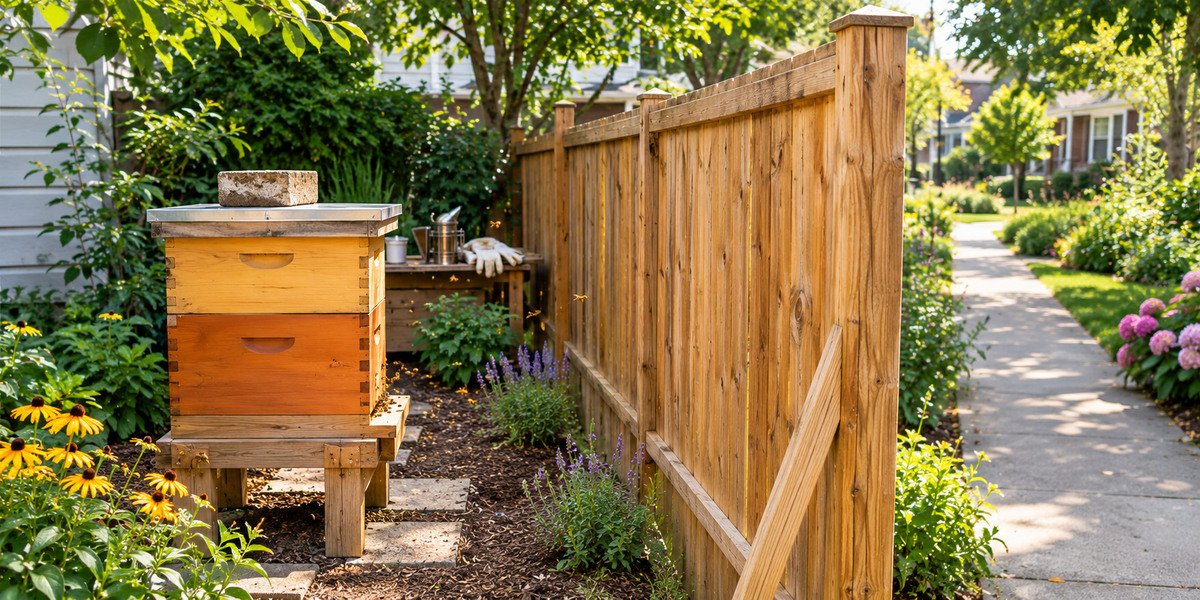
A solid wall or dense hedge between the entrance and shared space encourages climbing before bees cross the boundary. Oregon State’s residential guidance describes barriers at least 6 feet high, while local rules may specify another design. For a straight screen, the guide suggests extending approximately 10 feet beyond each side of the apiary. Keep inspection access outside the concentrated entrance traffic, and never block a needed exit or shared walkway.
A deciduous hedge can develop winter gaps, so inspect the screen when leaves drop and plants are pruned. A fence must remain structurally secure under local wind conditions without obstructing emergency exits. Obtain permission before attaching screening to shared boundaries or a neighbor’s property.
After installing a barrier, check whether redirected flights now cross an upstairs balcony or public stair. Departing foragers spread through the neighborhood and may still land on flowers in adjacent gardens. A solid screen also reduces accidental contact between visitors and equipment that could be disturbed. Leave inspection clearance because a close barrier can make lifting and carrying boxes unsafe.
Observe behavior after the colony becomes established and adjust the approach if traffic remains uncomfortable. Do not describe a fence as a promise that no bees will visit neighbors. When a suitable barrier cannot fit safely, another hive position may be the responsible choice.
Place Urban Bee Water Away From Neighbor Activity
Establish an on-property water source before introducing bees, especially where neighbors have pools or birdbaths. Choose a site that is quiet, easy to refill, and separate from doors and outdoor seating. Water collection intensifies during hot weather because colonies use evaporation to help regulate hive temperature.
A shallow basin with corks, pebbles, or floating wood offers stable landing sites and reduces drowning risk. Position the station where bees can land safely without forcing people through an active gathering area. Test a sunny morning position, then watch whether afternoon heat evaporates water faster than you can refill it. Avoid placing water directly under entrance flight traffic or where hive debris may contaminate it.
Set out water before installing bees so foragers can encounter it early in the season. Bees may nevertheless choose another source because mineral content, warmth, and previous experience influence water collection. Keep your station available while monitoring whether bees actually use it.
Put the basin on a surface that can drain safely and does not direct overflow toward adjoining property. Replace stagnant water and clean landing surfaces before mosquito larvae or algae become a maintenance problem. Do not add pesticides, fragrances, household cleaners, or untested attractants to drinking water. Keep the surrounding area tidy so a helpful station does not become another neighborhood nuisance.
If bees ignore your first location, experiment with sunlight, landing surfaces, and stable water availability. Do not place a new station beside a neighbor’s favorite chair merely because bees already congregate there. Judge the station by observed bee use, safe footing, easy refilling, and dependable operation during absences.
Keep Urban Bee Water Available During Heat and Absences
During hot spells, check the station each morning until observations establish a reliable consumption pattern. Evaporation can empty a shallow pan faster than the beekeeper expects, especially on an exposed roof. Mark the water level at refilling and compare remaining water after the hottest part of the day.
Before a short absence, ask a reliable caretaker to inspect the station and refill it safely. Provide written instructions describing the location, water source, and how to avoid approaching hive entrances. A covered reservoir with a shallow accessible outlet can reduce refill frequency without creating an open drowning basin. Test the setup during several warm days before leaving it under a neighbor’s or caretaker’s supervision.
Check for leaks, algae, fouled landing stones, and containers displaced by animals or strong winds. Clean the station without leaving detergent residues that might affect bees or other wildlife. Where freezing occurs, adjust the seasonal arrangement rather than allowing water to become inaccessible.
Once water collectors learn a neighbor’s pool, a new basin may not redirect those established foragers immediately. Keep the alternative filled and ask the pool owner which safe access adjustments are acceptable. Avoid promising that a new pan will immediately redirect trained foragers away from an established site. Persistent conflicts may require advice from a local bee association or changes to hive location.
Record periods of unusually high water use alongside heat, brood activity, and colony observations. The notes help distinguish ordinary seasonal demand from a station that leaks or repeatedly dries out.
Discuss Urban Hive Plans With Immediate Neighbors
Visit the immediate neighbors before installation, beginning with anyone whose doors or windows overlook the entrance. Show the proposed flight route, water station, emergency access, and the contact number for an urgent problem. Ask when neighboring children play outside, whether patios are frequently occupied, and who maintains the shared boundary.
A marked sketch can reveal conflicts that a friendly conversation misses, such as a gate hidden behind the hedge. Describe how you will handle swarms, nuisance water visits, and a colony that becomes unusually defensive. Avoid claiming that bees will never visit neighboring flowers or that every sting can be attributed to your colony. Agree on advance notice before disruptive work and identify the person authorized to help when you are away.
Give a working contact number and identify another experienced beekeeper who can help during an absence. Agree on a suitable method for receiving concerns without disturbing residents or sharing personal details publicly. Keep notes about any access restrictions or changes that affect the operating plan.
When someone reports a concern, propose a concrete adjustment instead of repeating that managed honey bees are usually calm. If a household regularly entertains beside the fence, adjust entrance orientation or inspection timing where possible. Written permissions should be retained separately from friendly conversations and should match actual ownership arrangements.
Some neighbors will be curious, while others may want only a quiet, predictable boundary. Respect both responses and prioritize safe management over persuading everyone to enjoy bees.
Time Urban Hive Inspections Around Neighbor Activities
Aim for fair-weather, mid-morning or early-afternoon inspections, when many foragers may be away collecting food. Postpone discretionary inspections if unprotected people are within roughly 10 feet of the hive, as Oregon State advises. Arrange smoke direction and equipment staging before opening the lid, particularly near windows and shared doors. An urgent welfare issue can justify a different inspection time, but still requires controlled access and protective measures.
Cool, wet, windy, or stormy conditions can increase handling difficulty and make postponement the safer decision. A sudden nectar shortage can heighten robbing risk, so avoid leaving comb and honey exposed. Compare the seasonal changes in first-year beekeeping with the periods when neighbors use outdoor spaces most.
Lay out the tools and covered spare box before lighting the smoker so the hive stays open briefly. Use cool smoke sparingly and position the smoker so passing wind does not carry smoke into neighboring windows. Close the hive promptly if manipulation triggers heavy robbing or unusually defensive behavior. Never leave open frames unattended while answering questions at a boundary.
Watch the landing board for pollen loads, guards fighting robbers, and unusual traffic before deciding whether to open. That distinction can reduce unnecessary hive openings while still revealing water, traffic, or robbing concerns. Use judgment and local mentoring when deciding whether suspected disease or queen problems require immediate examination.
Give neighbors advance notice before hive relocation or swarm retrieval if the operation changes common access. After the inspection, collect loose comb, syrup containers, tools, and smoker debris from the area. Regular, tidy work builds trust more reliably than assurances unsupported by daily practice.
Address Urban Bee Complaints Before Conflicts Grow
Respond to a complaint with a simple sequence: document the observation, inspect the likely cause, act, and follow up. Ask where and when insects appeared, whether anyone was stung, and whether a photograph exists. Check hive behavior and other possible bee sources without dismissing the neighbor’s experience. Offer a measurable response, such as turning an entrance or refilling water, and agree on a follow-up date.
Bees seen on flowers or water cannot usually be traced to one hive by appearance alone. Look for patterns near your entrance and consult a local beekeeper when an observation remains ambiguous. Do not assume every stinging insect reported nearby was a honey bee.
Unusually defensive bees call for prompt assessment of queen status, colony stress, disturbance, and available forage. Consider requeening or relocating with qualified local support when site changes cannot reduce the risk. Keep children and other bystanders away from an agitated hive while work is planned.
The problem may be a newly used walkway or seating area rather than a change in colony temperament. Use the practical challenges of beginner beekeeping to assess whether you can respond quickly enough. An unsafe location should be changed even when the original placement satisfied the legal minimum.
Log the complaint, weather, colony behavior, change made, and the neighbor’s report after mitigation. If a swarm settles over a neighbor’s doorway, arrange experienced collection and obtain permission before entering their property. For a sting emergency, prioritize the person’s immediate safety and local emergency guidance rather than colony inspection. If reasonable mitigation fails, moving the hives may protect neighbors and your ability to keep bees elsewhere.
Good urban beekeeping depends on responsive management after installation, not merely a compliant original site plan.
| Observed problem | Check first | Proportionate response |
|---|---|---|
| Bees visiting a neighbor’s pool | Whether the on-site source is consistently supplied, accessible, and has safe landing surfaces. | Maintain an attractive alternative and coordinate acceptable pool-side adjustments; established foragers may not switch immediately. |
| Bees crossing a shared path at head height | Actual entrance direction, busy pedestrian times, and gaps around existing screening. | Redirect the corridor with revised orientation or a secure barrier; relocate the hive if conflict persists. |
| Unusually defensive hive near residents | Colony handling, recent disturbance, weather, food availability, and possible queen or health issues. | Close the hive, protect nearby users, and get experienced local help before resuming disruptive work. |
| Swarm settled beyond the property line | Where the cluster is located, whether people need to keep clear, and whom to contact for collection. | Arrange an experienced swarm collector and obtain permission before entering another property. |
| Bees crowding spilled syrup or exposed comb | Leaky feeders, uncovered supers, unprotected stored equipment, and robbing activity. | Cover or remove attractants, clean leaks, use appropriate internal feeding, and seek local advice if robbing continues. |
| Smoker smoke entering neighboring windows | Wind direction, nearby open windows, and whether inspection can safely be postponed. | Choose a more suitable time and smoke position; maintain clear shared access and follow local fire restrictions. |
Frequently Asked Questions about Urban Beekeeping Basics
Can I keep an urban beehive on rented property?
For rented premises, secure written consent covering the exact site and colony count before acquiring bees. A lease may prohibit livestock, commercial activity, or alterations even when the municipality allows beekeeping. Shared gardens and roofs usually need additional approval from whoever controls those spaces. Ask permission for the specific hive location, number of colonies, access route, and water arrangements.
Clarify who can enter the property to handle bees during an emergency or your absence. Discuss whether fencing, water access, or building fixtures may be changed without violating the lease. Agree how you will remove colonies if the tenancy ends or the owner withdraws permission.
Keep the approval with your municipal paperwork and the contact details of your local mentor. Do not order bees until access, handling responsibilities, and removal procedures have been resolved. A workable rental arrangement protects residents and avoids leaving a live colony without authorized care.
How can I protect urban hives from vandalism without blocking access?
Prefer a lockable location away from public view, while preserving a second person’s safe emergency access. Use a secure gate or enclosure that allows you and an emergency helper to approach safely. Avoid fastening a hive to structural elements without permission or professional advice about the attachment. Clearly identify any hazard for authorized maintenance workers while keeping public access appropriately restricted. Check locks, paths, and hive stability after storms or changes in surrounding property use.
How can I tell whether bees visiting a neighbor came from my urban hive?
You usually cannot identify which managed hive a flower-visiting bee came from by its appearance alone. Foragers range beyond property boundaries and can visit water or flowers shared by many colonies. Record the location, time, and number of insects before drawing conclusions about a nuisance. Confirm the insects are honey bees rather than wasps or another species when safe to observe.
Compare the report with entrance activity and changing water or forage conditions near your apiary. A local association may help assess behavior when several apiaries operate in the neighborhood. Investigate practical mitigation without insisting that uncertainty about origin invalidates the neighbor’s concern.
Should I add sugar to an urban bee water station?
No, use plain water and stable landing surfaces, not sugary liquid that converts the station into an outdoor feeding point. Sugar can attract additional foragers and may encourage robbing or unwanted gatherings around the station. Keep any supplemental colony feed in an appropriate hive feeder when management conditions require it. Prevent spills and clean residue because exposed sweetness draws insects into shared spaces.
Bees sometimes prefer water containing dissolved minerals, but recommendations for specific additives are not straightforward. Begin with clean water and observe whether a sunny, reliable station attracts water collectors. Do not improvise concentrations of salt or other chemicals without credible local guidance.
Change water regularly and avoid substances that could harm bees, pets, or surrounding plants. If bees use a neighboring source, adjust station placement and consistency before considering additives. A safe water station should solve an access problem without becoming a food attractant.
What can I do if my urban bees already use a neighbor’s swimming pool?
Offer a reliable alternative water station immediately, while explaining the problem to the pool owner. Choose a visible landing surface in a sunny, quiet location away from the neighbor’s busiest spaces. Water foragers may keep visiting a familiar pool even after a reliable alternative becomes available. Coordinate temporary pool-covering or other practical changes only with the owner’s agreement and safety needs. Expect progress to require consistent water availability and observation rather than one quick intervention.
Ask a local bee association for help if persistent visits cause conflict despite reasonable adjustments. Avoid chemicals or improvised repellents that could create hazards around swimming areas. If repeated visits remain substantial, review whether the hive site is appropriate for that property.
How should I respond if my urban bees swarm onto neighboring property?
Contact an experienced local swarm collector promptly and explain the location without approaching the cluster unnecessarily. Keep children, pets, and bystanders away from the swarm while a safe response is arranged. Do not enter neighboring land, climb structures, or dismantle property without the owner’s permission. Share accurate contact details and avoid promising an immediate removal before help is confirmed.
A clustered swarm is often temporarily resting, but location and public access determine the urgency. An established colony inside a wall or structure requires a different removal approach from an exposed swarm. If people face immediate danger, follow the applicable local emergency procedures.
After the incident, review colony congestion, queen management, available space, and your seasonal inspection records. Swarm prevention involves management decisions before the event, not simply retrieving bees after they leave. Let neighbors know what adjustments you plan and when you will review their effectiveness.
Record the incident and use local mentoring to improve the next season’s swarm-management plan.
What should I do if a neighbor plans to spray pesticides near my urban hives?
Ask for the product identity, application location, and planned timing so you can evaluate the exposure risk. Encourage the applicator to follow label directions and avoid treating flowering plants while bees are actively foraging. Consult your local extension service or pesticide regulator about beekeeper notifications and applicable restrictions. Do not move or seal hives impulsively, because ventilation and colony handling may introduce other hazards.
Does a flight barrier keep all urban bees out of neighboring gardens?
No, flight barriers redirect concentrated traffic near the hive rather than confining foragers to one property. Foragers can still visit flowers, trees, and water throughout neighboring properties after gaining height. Barriers should reduce direct crossings of walkways rather than be presented as insect-proof boundaries. Check the actual pattern of traffic after the colony is established instead of trusting appearances.
Keep hedge growth dense enough to influence flights without limiting your own working space. If a fence redirects bees toward an upstairs balcony, reassess its position and height. Use entrance orientation, water placement, and respectful neighbor communication alongside any physical screen.
How can I limit smoker smoke near neighbors’ open windows during urban hive inspections?
Inspect when neighboring windows can remain clear of smoke, and check wind direction immediately before lighting the smoker. Use a functioning smoker with appropriate fuel and apply only the amount needed for calm handling. Tell neighbors about planned hive work when they may wish to close a window temporarily. Follow local fire safety rules and keep suitable extinguishing equipment available.
Place the lit smoker securely where it cannot scorch decking, roofing, or dry vegetation. Do not leave it unattended during an interruption or carry it through crowded shared corridors. Extinguish and cool equipment completely before storage or transport.
If weather sends smoke directly into living spaces, postpone non-urgent work until conditions improve. Short, well-prepared inspections usually create less disturbance than prolonged searches for missing tools. Record recurring smoke complaints and change the procedure rather than treating them as unavoidable.
How can urban beekeepers prevent robbing during feeding or honey harvests?
Keep open syrup, dripping feeders, wet supers, and uncovered comb away from foragers during nectar dearths. Use suitable internal or enclosed feeding arrangements instead of distributing sweet feed outside the colony. Work efficiently during nectar shortages and keep removed supers and comb covered. Clean accidental spills promptly because accessible sugar can attract bees from nearby colonies.
Watch for bees fighting at entrances, searching cracks, or flying chaotically around weak colonies. If robbing starts, close exposed equipment and reduce access to vulnerable colonies using appropriate entrance control. Seek experienced local help when a colony cannot defend its entrance or robbing persists.
Plan honey removal so wet frames, cappings, and extraction containers stay covered or inside bee-tight spaces. Do not assume an ordinary inspection schedule remains suitable during a severe forage dearth. Review colony strength and seasonal food stores before deciding whether supplemental feeding is needed.
Keeping attractive food sources contained protects colonies and reduces nuisance bee traffic around neighbors.
What to Remember About Urban Beekeeping Basics
Urban beekeeping basics come down to four checks: permission, a safe flight corridor, reliable water, and neighbor access. A well-positioned hive should leave clear routes for the beekeeper while minimizing concentrated traffic through shared spaces. Neighbors also need a dependable way to raise concerns and receive practical follow-up.
Before installing bees, sketch the boundaries, test the barrier and working lane, and establish a maintained water source. Ask an experienced local beekeeper to review the layout where access, a rooftop, or sensitive neighbors complicate the plan. Start with only the colonies you can manage responsibly, then reassess the arrangement as conditions change.